
An EtG calculator estimates the detection window for ethyl glucuronide (EtG) — an alcohol biomarker — in urine based on drinks consumed, body weight, and time elapsed. Results above 500 ng/mL typically indicate recent heavy drinking; below 100 ng/mL is usually considered negative.
Introduction
You’ve just received your EtG calculator results — and now you’re staring at a number wondering what it actually means.
Whether you’re preparing for a court-ordered alcohol monitoring program, an employment drug screen, a substance use treatment evaluation, or simply trying to understand your body’s response to alcohol, EtG results can feel confusing and high-stakes.
This guide breaks down everything you need to know:
- What each numerical result range means
- How accurate online EtG calculators are
- What factors change your results
- What to do if your result is higher or lower than expected
- How testing labs and legal programs interpret EtG values
This is not a guide to “beat” a test. It is a medically grounded, transparency-first resource to help you understand a biomarker that has real consequences in legal, clinical, and employment settings.
1. What Is an EtG Calculator?
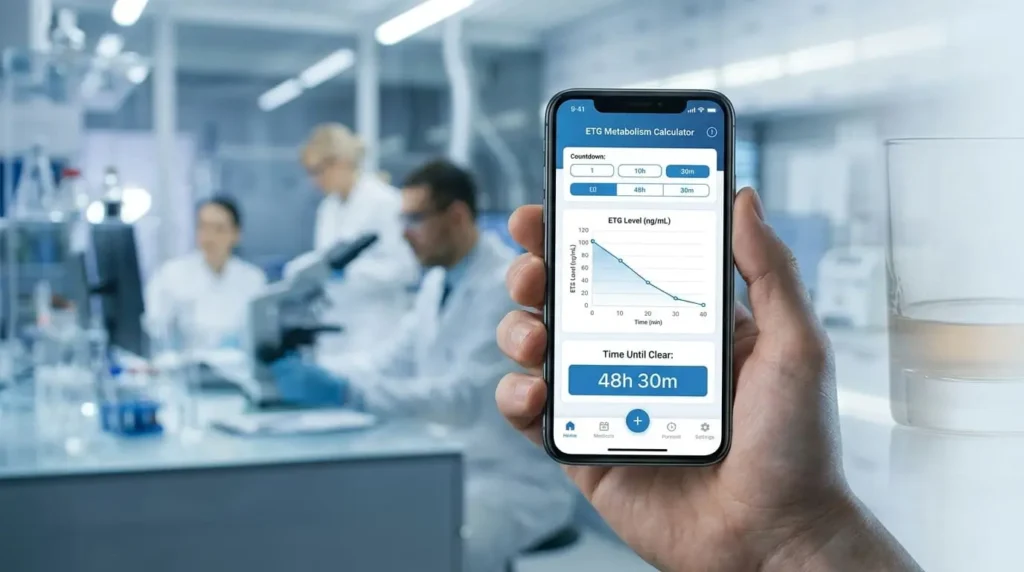
An EtG calculator is an online estimation tool that predicts how long ethyl glucuronide (EtG) will remain detectable in your urine after alcohol consumption.
EtG is a direct metabolite of ethanol (alcohol). When your liver breaks down alcohol, a small portion is converted into EtG — a water-soluble compound that passes through the kidneys and exits in urine.
Because EtG stays in the body longer than alcohol itself, it has become a preferred biomarker for detecting recent alcohol use — not just current intoxication.
What EtG Calculators Do
What they estimate:
- Time until EtG drops below detectable cutoff levels (typically 100–500 ng/mL)
- Rough EtG concentration based on drinks consumed
- Detection window based on body weight and metabolism estimates
What they cannot do:
- Replace a certified laboratory urinalysis
- Account for individual metabolic variation with precision
- Provide legally admissible results
- Predict exact ng/mL values for a specific individual
Expert Insight: Online EtG calculators use population-average pharmacokinetic models. Individual results can vary by ±40–60% depending on metabolic factors, hydration, liver health, and other variables. Always treat calculator outputs as estimates, not certainties.
2. How EtG Is Produced in the Body
Understanding your results starts with understanding the biology.
The EtG Pathway
- You consume alcohol (ethanol)
- Your liver metabolizes ~90–95% of ethanol via alcohol dehydrogenase (ADH) and acetaldehyde
- The remaining ~0.5–1.5% of ethanol is conjugated with glucuronic acid in the liver → producing EtG
- EtG enters the bloodstream and is filtered by the kidneys
- EtG is excreted in urine (primary detection medium), and to a lesser extent in hair and blood
EtG Half-Life
- EtG has a urinary half-life of approximately 2–3 hours
- However, because it is continually produced while any alcohol remains in the system, total detection can extend up to 80 hours after heavy drinking
EtS (Ethyl Sulfate) — The Companion Biomarker
EtG is often tested alongside EtS (ethyl sulfate), another alcohol metabolite. Many labs run a confirmatory EtS test when EtG is positive to reduce false positives. A positive EtG with positive EtS is considered a much more reliable indicator of actual alcohol consumption.
3. How to Read Your EtG Calculator Results
Most EtG calculators output one of the following:
Result Format Types
| Output Type | What It Shows |
|---|---|
| Estimated ng/mL concentration | Predicted EtG level at a given time point |
| Hours until undetectable | Time until EtG drops below a defined cutoff |
| Detection window (range) | Min–max window based on variable inputs |
| Risk tier (Low / Medium / High) | Simplified interpretation of detection likelihood |
Reading a Concentration-Based Result
If your calculator shows a predicted ng/mL value, compare it to these standard reference ranges:
| EtG Level (ng/mL) | Interpretation |
|---|---|
| < 100 | Below standard cutoff — typically reported as Negative |
| 100–499 | Low positive — may indicate incidental exposure or light/distant drinking |
| 500–999 | Moderate positive — consistent with recent moderate alcohol use |
| ≥ 1,000 | High positive — consistent with significant recent alcohol consumption |
| ≥ 5,000 | Very high — consistent with heavy or binge drinking |
Note: These cutoff tiers vary by testing program. Some programs use a 100 ng/mL cutoff; others use 500 ng/mL. Always confirm the cutoff level used by your specific testing program.
4. EtG Cutoff Levels Explained
The cutoff level is the threshold below which a test is reported as negative — regardless of whether trace EtG is present.
Standard Cutoff Levels in Use
| Cutoff Level | Common Use Context |
|---|---|
| 100 ng/mL | High-sensitivity programs (DUI monitoring, probation, treatment programs) |
| 200 ng/mL | Some clinical and workplace programs |
| 500 ng/mL | Standard workplace / general screening programs |
Why Cutoffs Matter for Your Calculator Results
If your calculator predicts your EtG at 350 ng/mL at the time of testing:
- You would pass a 500 ng/mL cutoff test
- You would fail a 100 ng/mL cutoff test
This is why knowing your program’s specific cutoff is critical before interpreting calculator results.
SAMHSA Guidelines on EtG Cutoffs
The Substance Abuse and Mental Health Services Administration (SAMHSA) has historically cautioned against using EtG at 100 ng/mL as a sole definitive indicator of alcohol consumption due to false positive risk from incidental exposure (mouthwash, hand sanitizer, fermented foods). SAMHSA recommends 500 ng/mL for more conservative interpretation. (Source: SAMHSA Advisory on EtG Testing, 2006)
5. EtG Detection Window by Drinking Amount
General Detection Windows (Population Averages)
| Drinking Level | Standard Drinks | Approx. EtG Detection Window |
|---|---|---|
| Light | 1–2 drinks | 12–24 hours |
| Moderate | 3–4 drinks | 24–36 hours |
| Heavy | 5–8 drinks | 36–60 hours |
| Binge/Heavy | 9+ drinks | 60–80 hours |
Note: “Standard drink” = approximately 14g pure alcohol (12 oz regular beer, 5 oz wine, 1.5 oz spirits)
The “80-Hour Window” — Fact vs. Myth
You’ve likely heard “EtG can detect alcohol for up to 80 hours.” This is accurate — but only in heavy drinking scenarios.
For light consumption (1–2 drinks), the window is typically 12–24 hours. The 80-hour window applies primarily to prolonged heavy consumption (multiple days of heavy drinking or a single very heavy episode of 10+ drinks).
Interpreting a light drinking event through an 80-hour lens is one of the most common misunderstandings users bring to EtG calculators.
6. Factors That Affect Your EtG Calculator Results
EtG metabolism is not uniform across individuals. The following variables can significantly alter your actual result relative to a calculator’s estimate.
Biological & Metabolic Factors
| Factor | Effect on EtG Levels |
|---|---|
| Body weight | Higher weight generally dilutes EtG concentration in urine |
| Metabolic rate | Faster metabolism clears EtG more quickly |
| Liver function | Impaired liver (cirrhosis, fatty liver) may slow EtG clearance |
| Age | Older individuals often metabolize alcohol more slowly |
| Sex (biological) | Women typically have lower alcohol dehydrogenase activity — slower clearance |
| Genetics | ADH and ALDH gene variants affect alcohol metabolism significantly |
Lifestyle & Behavioral Factors
| Factor | Effect |
|---|---|
| Hydration level | High fluid intake dilutes urine → lower ng/mL reading |
| Food consumption | Eating before/during drinking slows absorption |
| Sleep deprivation | May affect metabolic rate and clearance timing |
| Medications | Some drugs (e.g., metronidazole, cephalosporins) may affect EtG metabolism |
Environmental / Incidental Exposure Factors
This is where many people are surprised. EtG can be elevated by non-beverage sources:
- Mouthwash containing alcohol (e.g., Listerine) — can elevate EtG above 100 ng/mL
- Fermented foods (kombucha, certain vinegars, overripe fruit)
- Alcohol-based hand sanitizers (less likely to cause false positives above 500 ng/mL but documented in some cases)
- Cough syrups and liquid medications containing ethanol
- Religious/ceremonial wine consumption
Critical Warning: If you are in a zero-tolerance alcohol monitoring program, eliminate all potential incidental ethanol exposure — not just beverage alcohol. Use alcohol-free mouthwash, check medication ingredients, and avoid fermented products.
7. EtG vs. Other Alcohol Biomarkers
Understanding where EtG fits among other tests helps contextualize your results.
| Biomarker | Detection Window | Matrix | Detects |
|---|---|---|---|
| Blood Alcohol Concentration (BAC) | Up to 12 hours | Blood/breath | Current intoxication |
| EtG (Ethyl Glucuronide) | Up to 80 hours | Urine/hair/blood | Recent alcohol use |
| EtS (Ethyl Sulfate) | Up to 36 hours | Urine | Recent use (confirmatory) |
| PEth (Phosphatidylethanol) | 2–4 weeks | Blood | Chronic/heavy use |
| CDT (Carbohydrate-Deficient Transferrin) | 2–4 weeks | Blood | Chronic heavy drinking |
| GGT (Gamma-Glutamyl Transferase) | Weeks | Blood | Liver stress from drinking |
| Hair EtG | Up to 90 days | Hair | Long-term pattern of use |
When EtG Is the Right Test
EtG urine testing is most appropriate for:
- Short-term abstinence monitoring (days, not weeks)
- Random alcohol testing programs
- Post-incident screening
- Clinical sobriety verification
PEth or CDT are preferred for assessing chronic use patterns over longer periods.
8. Who Uses EtG Testing and Why
Legal & Criminal Justice
- DUI/DWI probation programs — regular random EtG testing is a standard condition in many U.S. states
- Drug courts — alcohol-free conditions monitored by EtG urine tests
- Child custody cases — courts may order EtG testing to monitor parental sobriety
- Ignition interlock programs — may be supplemented with periodic EtG tests
Workplace Testing
- Safety-sensitive industries — transportation (DOT-regulated employees), aviation, healthcare, nuclear
- Post-incident testing following workplace accidents
- Return-to-duty programs following prior alcohol violations
Clinical & Treatment Settings
- Inpatient rehabilitation centers — ongoing sobriety verification
- Outpatient addiction treatment — compliance monitoring
- Liver transplant evaluations — many programs require documented alcohol abstinence verified by EtG testing
- Psychiatric inpatient programs where alcohol use is contraindicated
Personal Use
- Individuals self-monitoring their recovery milestones
- People trying to understand their alcohol metabolism
- Travelers or employees preparing for known testing dates
9. Common Mistakes When Interpreting EtG Results
Mistake #1: Assuming the Calculator Is Definitive
Calculator outputs are estimates based on population averages. Your actual result could differ by a significant margin. Never make a legal or employment decision based solely on a calculator output.
Mistake #2: Not Knowing Your Program’s Cutoff Level
The same EtG concentration can be a “pass” or “fail” depending on the cutoff. Know whether your program uses 100, 200, or 500 ng/mL before interpreting your calculator output.
Mistake #3: Treating the 80-Hour Window as Universal
The 80-hour window applies to heavy binge drinking. Light consumption (1–2 drinks) typically clears within 24 hours. Using the maximum window as a universal rule causes unnecessary anxiety.
Mistake #4: Ignoring Incidental Exposure Sources
Several non-beverage sources can elevate EtG above the 100 ng/mL cutoff. If you’re in a high-sensitivity program, audit all products you use that may contain ethanol.
Mistake #5: Over-Hydrating to “Flush” the System
While dilution lowers ng/mL concentration, many testing programs use creatinine ratio verification to flag diluted samples. A dilute sample may trigger a re-test or be flagged as a tampered specimen.
Mistake #6: Confusing EtG with Blood Alcohol Content (BAC)
EtG does not measure intoxication. You could have a zero BAC and still test positive for EtG. The two measure completely different things.
Best ETG Tools
10. EtG False Positives: Causes and Risks
A false positive EtG result — a positive test in someone who did not consume beverage alcohol — is a documented and recognized risk, particularly at the 100 ng/mL cutoff.
Documented Sources of False Positives
| Source | Risk Level | Notes |
|---|---|---|
| Alcohol-containing mouthwash | Moderate–High | Can elevate EtG above 100 ng/mL; use alcohol-free alternatives |
| Kombucha and fermented beverages | Moderate | Variable ethanol content; some commercial kombuchas exceed 0.5% ABV |
| Overripe/fermented fruit | Low–Moderate | Unlikely alone to push above 500 ng/mL |
| Hand sanitizer (topical use) | Low | Dermal absorption rarely significant; inhalation in enclosed spaces possible |
| Vanilla extract and flavorings | Low | Culinary use unlikely to produce significant EtG |
| NyQuil and liquid cold medicines | Moderate–High | Many contain 10–25% ethanol by volume |
Defending a False Positive
If you believe your EtG result is a false positive:
- Request a confirmatory EtS test (if not already run)
- Document all potential incidental exposure sources in the 24–48 hours prior to testing
- Request the raw ng/mL value (not just positive/negative)
- Consult a toxicologist or medical review officer (MRO) if the result has legal implications
11. EtG False Negatives: When Results Are Lower Than Expected
False negatives — negative EtG results despite recent alcohol consumption — are also possible.
Causes of Unexpectedly Low EtG Readings
- High urine flow (polyuria) — excessive hydration dilutes EtG concentration below cutoff
- Rapid metabolism — some individuals clear EtG faster than population averages
- Sample degradation — EtG can degrade in samples stored at room temperature; bacteria in UTI patients can metabolize EtG
- Timing — testing occurred outside the detection window for the amount consumed
UTI and EtG Degradation
This is a clinically important caveat: Gram-positive bacteria (particularly E. coli) present in urinary tract infections can degrade EtG in the sample after collection. This has been documented in peer-reviewed literature and can lead to false-negative results in patients with active UTIs. (Source: Journal of Analytical Toxicology, multiple peer-reviewed studies)
12. EtG Testing in Legal and Employment Contexts {#legal-employment}
In Court-Ordered Programs
Courts and probation officers typically interpret EtG results using a specific protocol:
- Confirmed positive at program cutoff = violation
- Dilute sample = often treated as a re-test trigger or potential violation
- Confirmed negative = compliant result
Many programs use random testing — you may be called to test on any day, reducing the predictability advantage of calculator tools.
In DOT-Regulated Workplaces
The Department of Transportation (DOT) regulates alcohol testing for safety-sensitive employees. DOT testing uses breath alcohol testing (BAT) as the primary method — not EtG urine tests — because DOT standards focus on current impairment, not past use.
EtG testing may be used in Return-to-Duty and Follow-Up testing protocols outside of standard DOT panels, per employer discretion.
Medical Review Officer (MRO) Role
In workplace testing, a Medical Review Officer (MRO) is a licensed physician who reviews positive results and considers medical explanations before a result is reported to the employer. If you have a legitimate medical explanation for incidental EtG exposure, the MRO process is where it should be raised.
13. Local EtG Testing Services and Providers
If you need professional EtG urine testing — rather than a calculator estimate — certified lab testing is available in most metropolitan areas.
Types of EtG Testing Providers
- CLIA-certified clinical laboratories — hospital labs, Quest Diagnostics, LabCorp
- Urgent care centers — some offer toxicology panels including EtG
- Occupational health clinics — specialized in workplace drug/alcohol testing
- Court-approved collection sites — required for legal compliance testing
- Mobile testing services — come to your location; available in major cities
Finding EtG Testing Near You
Search terms that will help you locate local providers:
- “EtG urine test near me”
- “alcohol biomarker testing [your city]”
- “certified drug testing collection site [your city]”
- “Quest Diagnostics EtG test [city/zip code]”
- “LabCorp alcohol metabolite testing [city]”
Typical EtG Test Costs by Region
| Region/Context | Estimated Cost Range |
|---|---|
| National lab (self-pay, Quest/LabCorp) | $30–$80 |
| Urgent care collection + lab | $50–$150 |
| Court-program designated site | Variable; often $25–$60 per test |
| Employer-paid workplace testing | N/A to employee |
Note: Prices vary by region, lab, and whether a Medical Review Officer review is included. Always verify current pricing with your local provider.
14. Decision Framework: What to Do After Getting Your Results
Use this framework based on your situation:
Scenario A: Your Result Is Below the Cutoff (Negative)
You are likely below detectable levels for your program’s cutoff.
Actions:
- Confirm the cutoff level used by your specific program
- Do not assume this means zero EtG is present — it means you’re below threshold
- If approaching a real test, avoid all incidental alcohol exposure for 24–48 hours
Scenario B: Your Result Is Above the Cutoff (Positive)
Your estimated EtG is above the program’s threshold.
Actions:
- Do not take the actual test until you are confident you are below threshold (if you have flexibility)
- If the test is mandatory and imminent, consult an attorney or MRO if you believe the result reflects incidental exposure
- Be prepared to document incidental exposure sources
Scenario C: Result Is Near the Cutoff (Within 20%)
Borderline results are the most unpredictable.
Actions:
- Treat as potentially positive due to individual variation uncertainty
- Increase sample size: recalculate with more conservative (heavier) drinking assumptions
- Consider waiting additional time before testing if possible
Scenario D: You’re Disputing a Lab Result
If a confirmed lab test comes back positive and you believe it’s wrong:
- Request a split specimen retest (if available and within time window)
- Consult a toxicologist or MRO
- Document all potential incidental exposure
- Consult a legal professional if the result has criminal or custody implications
Entity Glossary
| Term | Definition |
|---|---|
| EtG (Ethyl Glucuronide) | A direct, non-oxidative metabolite of ethanol used as a biomarker for recent alcohol consumption |
| EtS (Ethyl Sulfate) | A secondary alcohol biomarker used to confirm EtG results and reduce false positives |
| PEth (Phosphatidylethanol) | A blood-based biomarker for chronic/heavy alcohol use with a detection window of 2–4 weeks |
| CDT (Carbohydrate-Deficient Transferrin) | Blood biomarker for chronic heavy drinking; less sensitive for recent use |
| BAC (Blood Alcohol Concentration) | Measures current alcohol in the blood; reflects intoxication, not past use |
| ng/mL (nanograms per milliliter) | The unit of measurement for EtG concentration in urine |
| Cutoff Level | The threshold concentration below which a test is reported negative |
| SAMHSA | Substance Abuse and Mental Health Services Administration; U.S. federal agency setting substance use testing guidelines |
| MRO (Medical Review Officer) | A licensed physician who reviews positive workplace drug/alcohol test results for legitimate medical explanations |
| CLIA | Clinical Laboratory Improvement Amendments; federal certification for clinical lab quality standards |
| ADH (Alcohol Dehydrogenase) | Enzyme responsible for metabolizing ethanol in the liver |
| Glucuronidation | The metabolic process in which ethanol is conjugated with glucuronic acid to form EtG |
| Detection Window | The time period during which a substance or its metabolite can be detected at or above a defined cutoff |
| False Positive | A positive test result in the absence of the substance being tested for |
| False Negative | A negative test result despite the presence of the substance |
| DOT | U.S. Department of Transportation; regulates alcohol testing for safety-sensitive transportation employees |
| Pharmacokinetics | The study of how a substance is absorbed, distributed, metabolized, and excreted by the body |
People Also Ask (FAQs)
Q1: How accurate are online EtG calculators?
Online EtG calculators use population-average pharmacokinetic models and are estimates only — not clinical measurements. Individual variation in metabolism, hydration, liver function, and genetics can cause actual EtG levels to differ from calculator estimates by 40–60% or more. They are useful for general planning but should never be used to guarantee a specific lab result.
Q2: What EtG level is considered a fail?
The answer depends entirely on your testing program’s cutoff level. Most programs use either 100 ng/mL (high-sensitivity) or 500 ng/mL (standard). A result of 350 ng/mL would fail a 100 ng/mL cutoff program but pass a 500 ng/mL program. Always confirm your specific program’s threshold.
Q3: Can one drink cause a positive EtG test?
Yes — at a 100 ng/mL cutoff, a single standard drink could produce a positive EtG result for approximately 12–18 hours after consumption in most adults. At a 500 ng/mL cutoff, a single drink is much less likely to trigger a positive result.
Q4: Does drinking water lower EtG levels?
Drinking water increases urine flow, which dilutes EtG concentration in urine (lowering ng/mL). However, it does not accelerate the metabolic clearance of EtG from the body. Additionally, many testing programs check creatinine concentration to detect diluted samples, which may trigger a re-test or be flagged.
Q5: How long does EtG stay in urine after one drink?
For a single standard drink in an average adult, EtG typically remains detectable above 100 ng/mL for approximately 12–24 hours. Above a 500 ng/mL cutoff, it is rarely detectable after a single drink. Individual variation applies.
Q6: Can mouthwash cause a failed EtG test?
Yes. Alcohol-based mouthwashes (such as many Listerine formulations) contain significant concentrations of ethanol and have been documented to elevate urine EtG above 100 ng/mL. If you are in a zero-tolerance program, switch to alcohol-free mouthwash products. This is one of the most well-documented sources of false positive EtG results.
Q7: What is the difference between EtG and BAC?
BAC (Blood Alcohol Concentration) measures current alcohol in the blood and reflects present intoxication. EtG measures a metabolite of alcohol in urine and reflects past alcohol consumption — potentially up to 80 hours prior. A person can have a zero BAC and still test positive for EtG.
Q8: Can EtG testing detect drinking from 3 days ago?
For heavy or prolonged drinking (multiple days of heavy consumption or a very large single binge), EtG can remain detectable above 100 ng/mL for up to 80 hours — approximately 3.3 days. For moderate or light drinking, detection is typically limited to 24–48 hours.
Q9: Is EtG testing used for employment drug screening?
EtG urine testing is used by some employers, particularly in safety-sensitive industries and in return-to-duty or follow-up testing programs. However, standard DOT workplace alcohol testing uses breath alcohol tests (BAT), not urine EtG, because DOT standards focus on current impairment.
Q10: Can you fight a positive EtG result?
Yes. A positive EtG result can potentially be challenged through: (1) requesting a confirmatory EtS test, (2) documenting incidental non-beverage alcohol exposure, (3) requesting a split specimen retest, (4) consulting a Medical Review Officer (MRO) or toxicologist, and (5) engaging a legal professional if the result has criminal or family law implications.
Q: What does a high EtG level mean?
A high EtG level (≥ 1,000 ng/mL) in a urine test indicates significant recent alcohol consumption. Levels above 5,000 ng/mL are typically associated with heavy or binge drinking. The exact interpretation depends on the testing program’s cutoff and the time elapsed since drinking.
Q: How long is EtG detectable in urine?
EtG is detectable in urine for up to 80 hours after heavy alcohol consumption. For light consumption (1–2 drinks), the window is typically 12–24 hours. The detection duration depends on how much was consumed, the individual’s metabolism, and the testing cutoff level used.
Q: What is the normal range for EtG in urine?
People who have not consumed alcohol typically show EtG levels below 100 ng/mL — often undetectable. Most programs report anything below the cutoff (100–500 ng/mL depending on the program) as negative. There is no “normal range” in a clinical sense; EtG is either present or absent relative to the cutoff.
Q: Can EtG be positive without drinking alcohol?
Yes. EtG can test positive without beverage alcohol consumption through incidental exposure to ethanol-containing products such as alcohol-based mouthwash, liquid cold medicines (e.g., NyQuil), certain fermented foods and beverages (kombucha, overripe fruit), and in rare cases, hand sanitizers. This is most common at the sensitive 100 ng/mL cutoff.
Q: What factors affect EtG metabolism?
Key factors affecting EtG metabolism and detection include: body weight, biological sex, age, genetic variants in alcohol-processing enzymes (ADH, ALDH), liver function, hydration level, the amount and pattern of alcohol consumed, and concurrent use of certain medications. These variables explain why two people who drink the same amount can have significantly different EtG results.
Conclusion & Action Steps
Understanding your EtG calculator results means understanding both the science and the context.
EtG is a sensitive, reliable biomarker for recent alcohol use — but its interpretation is far from one-size-fits-all. Your program’s cutoff level, your personal metabolism, incidental exposure sources, and the timing of testing all determine whether a predicted concentration translates to a positive or negative result in a real test.
Your Action Steps
If you’re interpreting a calculator result before a real test:
- Confirm your program’s exact cutoff level (100, 200, or 500 ng/mL)
- Factor in individual variation — treat the estimate conservatively
- Eliminate all incidental alcohol exposure sources 48–72 hours before testing
- If the result is borderline, calculate additional time rather than risk it
If you’ve received an unexpected positive lab result:
- Request the raw ng/mL value — not just “positive”
- Document all incidental exposure sources from the prior 48–72 hours
- Request a confirmatory EtS test if not already run
- Consult an MRO or toxicologist
- Seek legal counsel if the result has criminal, custody, or employment consequences
If you’re in an ongoing monitoring program:
- Use only alcohol-free personal care products
- Check all medications and supplements for ethanol content
- Maintain consistent hydration — neither dehydrated nor excessively over-hydrated
- Understand your testing program’s dilution policies
EtG testing is a powerful tool for accountability and clinical monitoring. With the right knowledge, you can interpret your results accurately, advocate for yourself when needed, and make informed decisions about your health and compliance.