
ETG 100 ng/mL Calculator | Free Urine Alcohol Detection Estimator
ETG 100 ng/mL Calculator
Use our ETG 100 ng/mL Calculator to estimate your urine ethyl glucuronide (ETG) level in seconds — enter your details below.
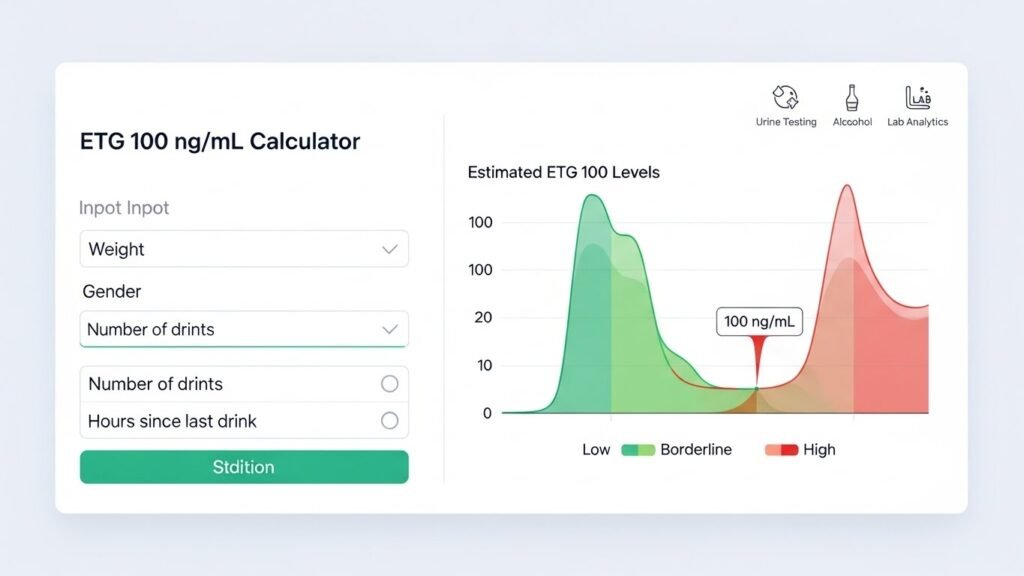
[ CALCULATOR TOOL — WEIGHT / GENDER / DRINKS / HOURS SINCE LAST DRINK / CALCULATE BUTTON ]
Result display:
- Estimated ETG (ng/mL)
- Risk indicator — 🟢 Below 100 ng/mL · 🟡 Around 100 ng/mL · 🔴 Above 100 ng/mL
This tool provides an estimate only and does not replace laboratory ETG testing.
Ethyl glucuronide (ETG) is a metabolite your liver produces when it breaks down alcohol. It stays in urine far longer than alcohol itself does, which is why ETG testing is the standard for detecting recent drinking in clinical, workplace, and legal settings. This calculator estimates whether your ETG level is likely to fall above or below the widely used 100 ng/mL cutoff, based on your weight, gender, number of drinks, and time since your last drink.
Last updated: July 2026
How the ETG 100 ng/mL Calculator Works
The calculator combines four inputs to estimate your urine ETG concentration:
- Weight — affects how alcohol is distributed through your body.
- Gender — men and women metabolize alcohol at different rates due to differences in liver enzymes and body composition.
- Number of drinks — each standard drink is calculated as roughly 14 grams of pure ethanol.
- Hours since your last drink — alcohol clears the body at an average rate of 0.015–0.017 g/dL per hour, and ETG levels fall as that clearance happens.
From these, the tool returns an estimated ETG concentration in ng/mL along with a color-coded risk read: green (below 100 ng/mL), yellow (around 100 ng/mL), or red (above 100 ng/mL).
How to Use It
- Enter your weight in kilograms.
- Select your gender.
- Enter the number of standard drinks consumed.
- Enter the number of hours since your last drink.
- Click Calculate ETG to see your estimated level and risk color.
Understanding the 100 ng/mL Threshold
Most labs use 100 ng/mL as the cutoff for a positive urine ETG result. This level is chosen because it’s sensitive enough to catch recent drinking while filtering out false positives from incidental exposure — things like hand sanitizer or mouthwash. Some stricter programs use a higher cutoff, around 500 ng/mL, for confirmation testing.
ETG is considered one of the more reliable alcohol biomarkers because, unlike blood alcohol content (which drops within hours), it typically stays detectable in urine for up to 3–4 days (roughly 80 hours) after drinking, depending on the amount consumed, body weight, hydration, and individual metabolism. Even a single drink can sometimes register, though levels from light drinking may sit close to or below the detection limit.
These interpretive limits are consistent with federal guidance on alcohol biomarker testing. According to a SAMHSA advisory on alcohol biomarkers hosted by the National Institute on Alcohol Abuse and Alcoholism, EtG and EtS testing should not be used as the sole basis for confirming alcohol use, since hydration levels affect measured concentration and results should ideally be corrected for it, with confirmatory lab methods used for any disputed positive. For readers who want the full clinical detail, the official SAMHSA advisory on alcohol biomarkers is publicly available.
What Affects Your ETG Level
| Factor | Effect on ETG |
|---|---|
| Amount of alcohol consumed | Higher intake raises ETG proportionally |
| Body weight & gender | Larger body mass or male metabolism generally lowers ETG per drink |
| Time since drinking | ETG declines steadily as alcohol is metabolized and excreted |
| Hydration | Diluted urine can temporarily lower ETG concentration |
| Individual metabolism | Genetic variation in liver enzymes speeds up or slows down processing |
The calculator accounts for the first three factors directly (weight, drinks, and time); hydration and individual metabolism are variables no calculator can fully control for — which is why this stays an estimate, not a diagnostic result.
Who This Calculator Is For
- People in alcohol recovery programs tracking abstinence
- Employers or occupational health staff explaining detection windows to employees
- Healthcare professionals walking patients through what an ETG result means
- Anyone who wants to understand how drinking translates into detectable ETG levels
Frequently Asked Questions
Can this calculator replace a lab test? No. It gives an estimate only. For legal, clinical, or employment decisions, results must come from a certified lab.
How long is ETG detectable? Generally up to 3–4 days (around 80 hours) after drinking, depending on how much was consumed, your body weight, and your metabolism.
Why is 100 ng/mL the standard threshold? It’s sensitive enough to catch recent alcohol use while minimizing false positives from incidental exposure like hand sanitizer or mouthwash.
Does hydration change the result? Yes — more diluted urine can lower the measured ETG concentration, even if the actual amount metabolized is the same.
Can one drink show up on an ETG test? Yes, it’s possible, though the estimated level from a single drink is often close to or below the 100 ng/mL cutoff.
Best ETG Tools
Related Reading
This calculator is for educational purposes and provides an estimate based on standard assumptions. It is not a substitute for laboratory ETG testing or medical advice.