
ETG calculators are for educational use only because they estimate alcohol metabolite clearance using population averages — not your individual biology. Factors like kidney function, hydration, medications, and body composition vary so significantly between people that no calculator can reliably predict whether you personally will pass an ETG urine test.
That’s the short answer. But if you’re reading this, you probably need more than that.
Maybe you have a test coming up. Maybe you already used a calculator and want to know how much to trust it. Maybe you’re a counselor, attorney, or healthcare provider trying to explain these limitations to someone who genuinely doesn’t understand why the math doesn’t apply to them.
Whatever the reason, this article covers everything — the science, the legal stakes, the real variables, and what you should actually do if an ETG result matters.
What Is an ETG Calculator?
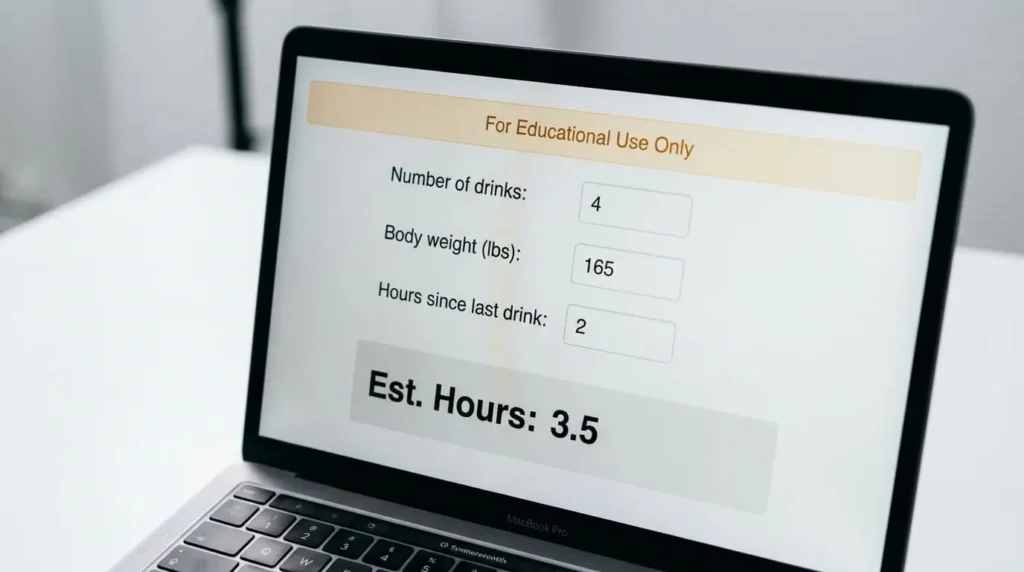
An ETG calculator is an online tool that estimates how long ethyl glucuronide (ETG) — a direct metabolite of alcohol — remains detectable in urine after drinking. You enter inputs like number of drinks, body weight, time since last drink, and sometimes gender or hydration level. The tool outputs an estimated “clearance window” — something like “ETG should be undetectable after 42 hours.”
These tools are built on two foundations: the Widmark Formula, which estimates blood alcohol concentration (BAC) from drinks consumed and body weight, and population-based ETG excretion curves drawn from controlled research studies.
The problem isn’t that these models are wrong. The problem is that they describe average people — and you are not an average.
Best ETG Tools
ETG urine testing is governed in the United States by standards set by the Substance Abuse and Mental Health Services Administration (SAMHSA). As the federal body responsible for clinical laboratory certification and substance use testing guidelines, SAMHSA defines the cutoff thresholds and chain-of-custody requirements that accredited labs must follow — standards no online calculator is built to replicate or replace.
How ETG Forms in Your Body
When you consume alcohol, your liver metabolizes ethanol through several pathways. Most of it becomes acetaldehyde, then acetate. A smaller portion gets converted into ethyl glucuronide by liver enzymes called UDP-glucuronosyltransferases (UGT). This ETG then moves through your bloodstream and gets excreted by the kidneys into urine — where it can be detected long after your blood alcohol has returned to zero.
This is why ETG tests are so valuable in monitoring settings. Breathalyzers and blood tests measure active intoxication. ETG urine tests detect that alcohol was consumed — sometimes up to 80 hours after the fact.
It’s also why calculators are difficult to build well. The clearance rate depends heavily on the kidneys, and kidney performance varies dramatically between individuals and even within the same person across different days.
Why the “Educational Use Only” Disclaimer Is a Scientific Statement
When you see “for educational use only” on an ETG calculator, many people assume it’s standard legal boilerplate — the same type of disclaimer you ignore on every website. It isn’t.
That disclaimer reflects a genuine scientific limitation. The tool is telling you that it can illustrate how ETG clearance generally works for a theoretical average person, but it cannot predict your result. Those are fundamentally different things.
Think of it like a weather model. A model might say it typically rains 60% of the time in a given region during July. That tells you something useful. But it doesn’t tell you whether it will rain at your exact location at 3pm next Tuesday. The model describes populations. You’re a specific event.
ETG calculators face the same problem, with higher stakes.
The Variables No Calculator Can See
This is the section most competing resources skip — and it’s the most important part of understanding why individual ETG clearance is so unpredictable.
Kidney Function ETG clears through the kidneys. Your glomerular filtration rate (GFR) — the speed at which your kidneys filter waste — determines how quickly ETG leaves your body. GFR varies based on age, hydration, underlying conditions, recent illness, and even daily fluctuations. Two people drinking identical amounts can have dramatically different ETG clearance simply because of kidney performance.
Hydration Status Drinking water doesn’t accelerate ETG metabolism — that happens in the liver. What water does is dilute the concentration of ETG in urine. Labs check creatinine and specific gravity alongside ETG for exactly this reason. A diluted specimen isn’t a clean specimen — it’s flagged as potentially invalid, which creates its own complications.
Body Composition Many calculators use body weight as a proxy for alcohol distribution volume. But two people at the same weight can have very different muscle-to-fat ratios. Alcohol distributes in body water, not fat. A person with high muscle mass will distribute ethanol differently than someone with higher body fat at the same weight.
Medications Certain drugs interact with alcohol metabolism and ETG excretion in ways calculators can’t account for. Proton pump inhibitors affect first-pass metabolism. Some antibiotics alter gut flora, which can affect ETG production. NSAIDs can influence renal perfusion. Anyone on Disulfiram (Antabuse) has a fundamentally altered metabolic pathway for acetaldehyde.
What You Drank Beer, wine, and spirits aren’t metabolically identical. Darker spirits and red wine contain congeners — organic compounds that may affect how your body processes alcohol and how ETG is produced. The strength and type of drink matters, and most calculators treat all alcohol as equivalent.
Incidental Exposure ETG is sensitive enough to detect alcohol from sources most people don’t think of as alcohol:
- Alcohol-based mouthwash
- Certain protein bars and health supplements
- Kombucha (some batches exceed 0.5% ABV)
- Cooking with wine or spirits
- Some over-the-counter cough syrups
A calculator has no way to know you used Listerine this morning.
Who Is Actually Subject to ETG Testing — and Why It Matters
The stakes attached to an ETG test vary enormously depending on who’s being tested and why.
| Population | Testing Context | Consequence of a Positive |
|---|---|---|
| DUI/DWI probationers | Court-ordered sobriety | Probation violation, incarceration |
| Drug court participants | Compliance monitoring | Program termination |
| Child custody cases | Parental fitness | Loss of custody or visitation |
| Healthcare professionals | Licensing board monitoring | License suspension or revocation |
| Commercial drivers (CDL) | DOT compliance | Career-ending disqualification |
| Addiction treatment patients | Outpatient accountability | Stepped-up treatment intensity |
| Pre/post-transplant patients | Organ eligibility | Removal from transplant list |
For every one of these groups, the difference between trusting a calculator and getting an actual test result isn’t just inconvenient — it’s potentially life-altering.
ETG Calculator vs. Certified Laboratory Test
Here’s what separates an estimate from a result:
| Feature | ETG Calculator | Accredited Lab Test |
|---|---|---|
| What it measures | Statistical model | Your actual specimen |
| Individual accuracy | Low to moderate | High |
| Court admissibility | Not admissible | Legally admissible |
| Detects incidental exposure | No | Yes |
| Can be confirmed | No | Yes (LC-MS confirmation) |
| Typical cost | Free | $30–$90 self-pay |
| Turnaround | Instant | Hours to 3 days |
LC-MS (liquid chromatography-mass spectrometry) is the gold standard confirmation method used by accredited laboratories. It measures the exact concentration of ETG in nanograms per milliliter (ng/mL) — a real number from your real specimen, not an estimate built on someone else’s averages.
International Differences in ETG Cutoff Standards
If you’re outside the United States, your testing program may operate under very different thresholds — and U.S.-built calculators may give you misleading reference points.
| Country | Common ETG Cutoff | Context |
|---|---|---|
| USA | 500 ng/mL (standard), 300 ng/mL (sensitive) | Probation, drug court, workplace |
| Germany | 100 ng/mL | Forensic, driving license reinstatement |
| UK | Varies by program | Family court, probation |
| Australia | Program-specific | Drug court |
| UAE | Zero tolerance | Legal/forensic |
Germany’s forensic threshold of 100 ng/mL is five times more sensitive than the standard U.S. monitoring cutoff. If you’re in Germany and using a U.S.-based calculator calibrated for 500 ng/mL, you may be significantly underestimating your risk.
What to Do If You’re Under Mandatory ETG Monitoring
If an ETG test has real consequences for you — legal, professional, or clinical — the only reliable strategy is one that doesn’t depend on timing or estimation.
1. Practice complete abstinence from alcohol. This includes beverages, mouthwash, and any products where alcohol content is ambiguous.
2. Switch to alcohol-free alternatives. Replace alcohol-based mouthwash with an alcohol-free formulation. Check labels on cough syrups and supplements before using them.
3. Know your program’s cutoff threshold. Ask your probation officer, treatment coordinator, or monitoring program: What ng/mL level counts as positive? Is there a dilution protocol? What happens if a specimen has low creatinine?
4. Disclose medications proactively. If you take any prescription or OTC medications that could affect ETG metabolism or excretion, inform the program’s Medical Review Officer (MRO) before a result comes back — not after.
5. If you want to know your actual ETG level, test yourself. Major labs including Quest Diagnostics and LabCorp offer self-pay ETG urine tests for $30–$90. This gives you a real result from your real specimen. Home ETG test strips are also available and can give threshold-level results at home, though they are less precise than laboratory confirmation testing.
6. Consult an addiction medicine physician if needed. The American Society of Addiction Medicine (ASAM) maintains a provider directory at asam.org. A physician familiar with your health history can give personalized guidance that no calculator can.
ETG vs. ETS — Understanding the Difference
Many monitoring programs test for both ethyl glucuronide (ETG) and ethyl sulfate (ETS) simultaneously. Understanding why matters.
ETS is another direct alcohol biomarker produced during metabolism, but it has a slightly shorter detection window than ETG. More importantly, ETS is less susceptible to incidental exposure than ETG — meaning a positive ETS result alongside a positive ETG result is considered stronger evidence of genuine alcohol consumption, not incidental contact.
If you’re challenging a positive ETG result, the presence or absence of ETS can be clinically and legally significant. Your MRO or attorney should understand this distinction.
Common Mistakes That Lead People to Trust Calculators They Shouldn’t
Underestimating drink size. A craft beer at 8% in a 16 oz pint is more than twice the alcohol of a standard drink. A generous restaurant wine pour may be 8–9 oz instead of 5. Miscounting inputs leads to systematically underestimated clearance times.
Assuming water speeds up clearance. It doesn’t. It dilutes concentration, which creates its own problems with specimen validity.
Ignoring incidental sources. Many people who fail ETG tests while genuinely not drinking consumed alcohol from mouthwash, kombucha, or a cooked dish without realizing it.
Treating the output as a guarantee. Even a well-built calculator is a model of average behavior. Research has documented ETG positive results more than 24 hours after only 2 standard drinks in some study participants. The range is real and wide.
FAQs
How accurate are ETG calculators? ETG calculators provide general estimates based on population averages, not individual biology. Research shows ETG clearance can vary by a factor of 2–3x between individuals consuming identical amounts. For personal accuracy, only laboratory urinalysis of your actual specimen provides a reliable result.
Can an ETG calculator tell me if I’ll pass a drug test? No. A calculator cannot account for your kidney function, medications, hydration, or body composition — all of which affect clearance. The output is an estimate of what an average person might clear in a given time. You may clear faster or significantly slower.
Why does ETG clearance vary so much between people? ETG is excreted by the kidneys, and kidney filtration rates vary widely. Additionally, the liver enzymes (UGT) that produce ETG vary in activity between individuals. Hydration, medications, body composition, and even stress hormones all influence the process.
Does drinking water help pass an ETG test? Water does not accelerate ETG clearance — it dilutes urine concentration. Testing labs measure creatinine and specific gravity to detect dilution. A diluted specimen is not the same as a negative result and may be flagged as invalid.
What is the ETG cutoff level for probation testing? In the United States, the most common ETG cutoff for probation and monitoring programs is 500 ng/mL. Some programs use 300 ng/mL for more sensitive monitoring. Programs in Germany use 100 ng/mL for driving license reinstatement. Always confirm the specific threshold with your monitoring program.
Can mouthwash cause a positive ETG test? Yes. Alcohol-based mouthwash can produce detectable ETG in urine, particularly at lower cutoff thresholds. At the standard 500 ng/mL U.S. cutoff, isolated mouthwash use is less likely to produce a positive, but risk exists. Anyone under ETG monitoring should use alcohol-free mouthwash.
What is the difference between ETG and ETS testing? Both are alcohol biomarkers detected in urine. ETG has a longer detection window; ETS has a slightly shorter one but is less susceptible to incidental exposure. Programs often test both together because a dual positive (ETG + ETS) is stronger evidence of actual alcohol consumption than ETG alone.
How long does ETG stay in urine after one or two drinks? For light consumption (1–2 standard drinks), ETG typically clears within 24–48 hours in most people under normal conditions. However, this is a population average. Some individuals test positive beyond 24 hours after minimal consumption. No calculator can tell you which side of that range you fall on.
Conclusion
ETG calculators are genuinely useful — for understanding how alcohol metabolism works, for education in clinical and academic settings, and for building general intuition about detection windows. That’s exactly what “for educational use only” means.
What they cannot do is tell you whether you specifically will pass your specific test on that specific day. The biology is too individual. The variables are too numerous. And the stakes — for too many people — are too high to leave to a statistical average.
If your situation involves a legal obligation, a professional license, a custody arrangement, or an addiction treatment program, the answer is not a better calculator. It’s complete abstinence, a conversation with a qualified professional, and — if you need to know your actual ETG level — a real laboratory test of your real specimen.
That’s not a disclaimer. That’s the science.