
A clinically grounded, globally applicable guide for individuals under alcohol monitoring, legal professionals, and program administrators — covering real exposure risks, cutoff thresholds, and step-by-step defense strategies.
Quick Answer:
Yes — second-hand and incidental alcohol exposure can produce detectable EtG levels in urine. However, passive sources rarely exceed the standard 500 ng/mL forensic cutoff. Sources like mouthwash, kombucha, and non-alcoholic beer carry the highest real-world risk of triggering a borderline positive result.
What Is an EtG Test and Why Is It So Sensitive?
Ethyl glucuronide, or EtG, is a minor metabolite produced whenever the human body processes ethanol — the type of alcohol found in beverages, mouthwash, hand sanitizers, and hundreds of other products. Unlike a standard breath or blood alcohol test, which can only detect drinking within a few hours, a urinary EtG test extends that detection window to anywhere from 24 to 80 hours after exposure, depending on how much alcohol was consumed.
The test works by identifying EtG in urine rather than ethanol itself. This distinction is critical: EtG is produced from any ethanol source, not exclusively alcoholic drinks. The liver enzyme UDP-glucuronosyltransferase (UGT) conjugates ethanol with glucuronic acid through a process called glucuronidation, and the resulting metabolite exits the body through urine. There is no biological “flag” that marks the metabolite from a glass of wine differently from the one produced by rinsing your mouth with Listerine.
According to the Substance Abuse and Mental Health Services Administration (SAMHSA), EtG testing should not be used as the sole evidence of alcohol consumption because incidental exposure from common products may produce detectable results. SAMHSA also recommends confirmatory testing such as LC-MS/MS for any disputed positive result. You can review the official advisory directly from SAMHSA here: The Role of Biomarkers in the Treatment of Alcohol Use Disorders, 2012 Revision
This extreme sensitivity is EtG’s defining feature and its most significant forensic weakness. In 2006, the Substance Abuse and Mental Health Services Administration (SAMHSA) issued a landmark advisory explicitly stating that EtG testing is “scientifically unsupportable” as the sole basis for legal or disciplinary action — a position it reaffirmed in a 2012 update that recommended confirmatory testing by LC-MS/MS or GC-MS for any presumptive immunoassay positive. This is not a fringe position: it comes from the same federal agency that governs the testing programs using the test.
Important: A companion biomarker called ethyl sulfate (EtS) is increasingly tested alongside EtG. EtS is produced through a different metabolic pathway and is far less susceptible to non-beverage sources and in-vitro artifact. The combination of a positive EtG with a negative or near-zero EtS is one of the strongest indicators of incidental rather than intentional exposure.
The Real Routes of Passive Alcohol Exposure
Second-hand or incidental alcohol exposure is not limited to being in a bar. Ethanol is an ingredient in over 400 household and personal care products, and the human body can absorb it through multiple routes that have nothing to do with drinking.
Inhalation
Being in an enclosed space with high ambient ethanol vapor — a busy bar, a bakery, a winery, or a space where ethanol-based cleaners are being used — can result in trace respiratory absorption. Studies have shown that passive inhalation of hand sanitizer vapor alone can produce immunoassay-positive EtG results in some individuals, though these typically clear within hours. One PubMed study found that passive inhalation of propanol-based sanitizer vapor produced immunoassay results up to 0.89 mg/L in exposed subjects — results that disappeared upon confirmatory LC-MS/MS testing, indicating a cross-reaction rather than true EtG (Pragst et al., PubMed: 23137849).
Dermal Absorption
Ethanol-based hand sanitizers (typically 60–80% ethanol concentration) and antiseptic products can allow transdermal absorption, particularly through broken or irritated skin. Studies using up-to-elbow sanitizer application under controlled conditions found EtG levels as high as 799 ng/mL in one subject — a concentration that would trigger a positive at the standard 500 ng/mL cutoff. Standard hand use produces far lower values, generally under 100 ng/mL.
Dietary Ingestion
This is arguably the most underappreciated route. A wide range of common foods and drinks contain ethanol in quantities that can produce measurable EtG:
- Non-alcoholic beer and wine: May contain up to 0.5% ABV by law in most countries; consuming multiple servings can push EtG above 300–800 ng/mL
- Kombucha: Commercial varieties range from 0.5–1.5% ABV; home-brewed batches can reach 3% or more with continued fermentation in the bottle
- Soy sauce: Contains approximately 2–3% ethanol; relevant only in very large quantities
- Vanilla extract: Up to 35% ethanol by volume, but tiny culinary amounts produce negligible EtG
- NyQuil and some cough syrups: NyQuil contains approximately 10% ethanol; a normal dose can produce detectable but usually sub-threshold EtG
- Dishes cooked with wine or beer: Cooking does not fully evaporate alcohol — research shows that between 5% and 85% of added ethanol can remain, depending on cooking method and time
Oral Hygiene Products
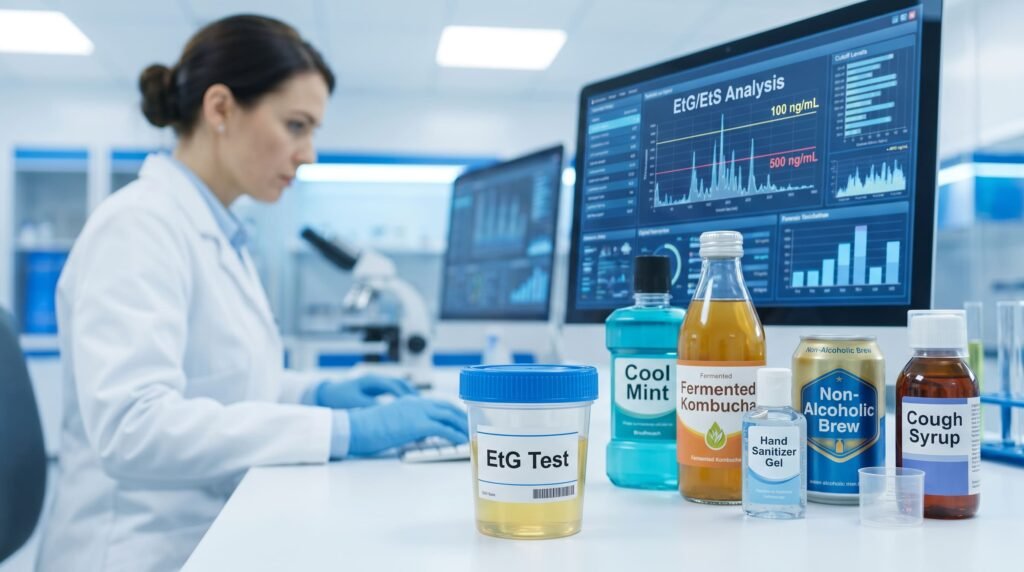
Alcohol-based mouthwash is one of the most consistently documented sources of borderline EtG false positives. Listerine Original, for example, contains approximately 26% ethanol. Studies by Costantino et al. found that normal mouthwash use produced EtG levels of 100–500 ng/mL in urine collected 2–4 hours after rinsing, with some participants briefly exceeding the 500 ng/mL threshold. If you are under any form of alcohol monitoring, switching to an alcohol-free alternative eliminates this risk entirely.
The Isopropanol Confusion — An Important Distinction
Many people subject to testing worry about rubbing alcohol (isopropanol or isopropyl alcohol). Here the answer is more nuanced than most sources explain. Isopropanol does not metabolize to EtG — it converts to acetone instead, which is not detected by EtG assays. However, propanol-based hand sanitizers can produce propyl glucuronides, which cross-react with some immunoassay EtG test kits and produce a false-positive screening result. This cross-reaction does not survive LC-MS/MS confirmatory testing. This is why a positive immunoassay must never be treated as definitive without mass spectrometry confirmation.
Exposure Source Risk Table: What Actually Triggers a Positive
The critical question is not whether a source produces EtG, but whether it produces enough to cross the cutoff threshold used by your specific testing program. Here is a risk-rated breakdown of the most common incidental sources:
| Exposure Source | Approx. Ethanol % | Typical EtG Range (ng/mL) | Risk @ 100 ng/mL | Risk @ 500 ng/mL |
|---|---|---|---|---|
| Alcohol-based mouthwash (Listerine) | 21–26% | 100–500 | High | Moderate |
| Non-alcoholic beer (2–3 servings) | up to 0.5% | 100–800 | High | Moderate |
| Kombucha — commercial (high ABV batch) | 0.5–1.5%+ | 300–1,200 | High | High |
| NyQuil / ethanol cough syrups | ~10% | 100–400 | Moderate | Low |
| Hand sanitizer — standard topical use | 60–80% | <50–100 | Low | Very Low |
| Vanilla extract (cooking amounts) | 35% | <50 | Very Low | Very Low |
| Ambient bar/nightclub (inhalation only) | Vapor trace | <50 | Very Low | Very Low |
| Ripe or fermented fruit | <1% | <50 | Very Low | Very Low |
| Wine-cooked sauce (large portion) | Residual | <100 | Low | Very Low |
Sources: Costantino et al. 2010; Høiseth et al. 2009; Reisfield et al. 2012; SAMHSA Advisory 2012; PubMed 23137849.
Understanding EtG Cutoff Thresholds
The cutoff is the number that determines whether your test is reported as positive or negative — and it varies significantly between programs. Knowing your program’s cutoff is arguably the single most important piece of information you can have.
| Cutoff | Sensitivity | Typical Program | False Positive Risk from Incidental Sources |
|---|---|---|---|
| 100 ng/mL | Extremely High | Some research or treatment programs | Very High — mouthwash, NA beer, kombucha all trigger |
| 200 ng/mL | High | Some court programs | High — kombucha and NA beer still a risk |
| 500 ng/mL | Moderate | Most certified labs, DOT, legal proceedings | Moderate — kombucha, mouthwash borderline |
| 1,000 ng/mL | Lower | Some workplace EAPs | Low — only heavy incidental exposure triggers |
SAMHSA explicitly recommends a minimum cutoff of 500 ng/mL for any program where results have legal consequences. At 100 ng/mL, the test is capable of detecting a single mouthwash rinse from the morning of the test. That is not evidence of alcohol use in any clinically meaningful sense.
The EtG/EtS Pattern: What Your Result Combination Actually Means
When both EtG and EtS are measured, the combination of results tells a much more complete story than EtG alone. EtS is not significantly produced by most incidental exposure sources, and it is not subject to in-vitro bacterial production the way EtG is. This makes it an important interpretive counterbalance.
| EtG Result | EtS Result | Most Likely Interpretation |
|---|---|---|
| Positive | Positive | Consistent with actual ethanol ingestion — strongest pattern for real consumption |
| Positive (low) | Absent / Very Low | Strongly suggests incidental exposure or in-vitro artifact — not beverage alcohol |
| Positive (high) | Absent | In-vitro production likely (diabetic patient, UTI, delayed specimen processing) |
| Negative | Negative | No significant ethanol exposure detected |
A hidden risk factor that almost no consumer-facing resource covers: patients with diabetes or urinary tract infections (UTIs) are at elevated risk for in-vitro EtG production. Bacteria and yeast in the urine can ferment glucose in the collected specimen, producing ethanol that then converts to EtG in the container — creating a positive result that has nothing to do with consumption. If you have either condition and face a positive EtG result, this must be raised immediately as a mitigating factor.
Best ETG Tools
Who Gets Tested with EtG — and What the Stakes Are
EtG testing is used across a wide range of legal, clinical, and professional settings globally. Understanding your context determines how a borderline result will be interpreted and what defense options are available.
- Drug courts and DUI/OWI courts: High-frequency monitoring with real legal consequences; cutoffs typically 500 ng/mL
- Probation and parole supervision: Alcohol abstinence conditions; positive results can trigger violation hearings
- Family and custody courts: Parental sobriety verification; false positives carry profound personal consequences
- Liver transplant candidacy programs: Strict abstinence verification; SAMHSA guidelines are closely followed
- Employee Assistance Programs (EAPs) and last-chance agreements: Workplace monitoring; program protocols vary widely
- Physician Health Programs (PHPs): Monitoring of healthcare professionals; high EEAT standards required
- Addiction treatment programs: Relapse detection; clinical context generally allows more nuanced interpretation
Global Regulatory Standards: How EtG Testing Differs by Country
No competitor currently covers this angle — yet it matters enormously if you are outside the United States.
| Country / Region | Governing Body | Standard Cutoff | Key Context |
|---|---|---|---|
| United States | SAMHSA, DOT | 500 ng/mL (recommended) | Most developed EtG regulatory framework; SAMHSA advisory is widely cited in legal proceedings |
| United Kingdom | MHRA, FSA (forensic context) | No national standard published | Used in DVLA driving license reinstatement and family court; lab-specific cutoffs apply; PEth increasingly preferred |
| Canada | Health Canada (no specific EtG guideline) | Provincial variation | Growing use in ignition interlock programs and custody proceedings; no federal cutoff standard |
| Australia | No national standard | Lab-specific | Family Court and DUI monitoring use EtG; increasing adoption but no published national cutoff guidance |
| European Union | Varies by member state | No EU standard | PEth is often preferred over EtG in clinical settings; EtG used in liver transplant and occupational health contexts |
Outside the United States, the absence of a nationally mandated cutoff means results are more open to lab-level interpretation — which can be both an advantage and a vulnerability for anyone contesting a positive result. In the UK and Australia, referencing the SAMHSA advisory in legal proceedings has been accepted as supporting documentation for challenging borderline results.
How to Defend Against a False Positive EtG Result
If you receive a positive EtG result and believe it reflects incidental rather than intentional exposure, this is the defense protocol used by forensic toxicologists and specialist defense attorneys.
- Request the exact numerical EtG value. Never accept a binary positive/negative report without knowing the actual concentration in ng/mL. A result of 115 ng/mL carries very different implications than one of 9,000 ng/mL. This information is your right in virtually every certified testing program.
- Confirm your program’s cutoff threshold. Ask explicitly whether the positive was reported at 100, 200, 500, or 1,000 ng/mL. If your result barely exceeds a 100 ng/mL cutoff, the scientific literature squarely supports an incidental exposure explanation.
- Request split-sample confirmatory testing. Any program using SAMHSA-certified or CLIA-certified laboratories is required to preserve a B-split of your specimen. Request that it be analyzed by LC-MS/MS or GC-MS — the only methods capable of distinguishing EtG from cross-reacting compounds like propyl glucuronides.
- Request EtS testing if not already performed. If EtG is elevated but EtS is absent or negligible, this pattern directly supports an incidental exposure interpretation and has been used successfully in legal proceedings. Demand this companion test.
- Document your exposure history. Write down everything consumed, used, or inhaled in the 72–96 hours before your test: all foods, beverages, medications, oral hygiene products, cleaning products, and occupational exposures. Save receipts. Note exact times.
- Consult a board-certified forensic toxicologist. A toxicologist certified by the American Board of Forensic Toxicology (ABFT) or affiliated with the Society of Forensic Toxicologists (SOFT) can provide a written expert opinion on whether your specific EtG level is consistent with your documented exposure sources. This opinion is admissible in legal proceedings in most jurisdictions.
- Engage legal counsel immediately. In any proceeding where a positive EtG result may be used against you — probation hearing, custody matter, employment action — do not respond without an attorney. Defense attorneys familiar with forensic toxicology can challenge both the methodology and the interpretation of borderline results.
⚠ Never do this: Do not attempt to dilute your urine by drinking excessive water before a test. Certified labs test creatinine concentration and specific gravity as part of specimen validity testing. An abnormally dilute specimen is flagged as a validity failure and treated as presumptively positive — often triggering harsher consequences than the original result would have.
Products to Avoid — and Safer Alternatives
If you are under EtG monitoring, these changes are simple, immediately effective, and require no medical intervention.
Stop Using These
- Alcohol-based mouthwash (Listerine Original, Scope, ACT with alcohol)
- Kombucha — especially home-brewed or artisanal batches with unknown ABV
- Non-alcoholic beer or wine (even products labeled “non-alcoholic” may contain up to 0.5% ABV)
- NyQuil and other OTC cold/flu syrups containing ethanol
- Herbal tinctures using ethanol as a solvent
- Vanilla extract used directly (not as a flavoring in baked goods)
Safe Alternatives
- Alcohol-free mouthwash: Biotene, ACT Dry Mouth (ethanol-free formulation), Colgate Total Alcohol-Free
- Non-ethanol hand sanitizer: benzalkonium chloride-based products (e.g., Zylast, Purell Naturals BZK formula)
- 0.0% ABV beverages: Heineken 0.0, Athletic Brewing (certified 0.0%), Seedlip (non-alcoholic spirits)
- Ethanol-free cough preparations: plain dextromethorphan syrups, guaifenesin-only formulations
- Check manufacturer certificates of analysis for any fermented product if uncertain
EtG vs. Other Alcohol Biomarkers: Choosing the Right Test
EtG is not the only tool available for alcohol monitoring, and understanding its position within a broader biomarker landscape is important for both individuals and program administrators.
| Biomarker | Specimen | Detection Window | Affected by Passive Exposure? | Best Use Case |
|---|---|---|---|---|
| EtG (urine) | Urine | 24–80 hours | Yes — most vulnerable | Recent use monitoring, compliance |
| EtS (urine) | Urine | 24–48 hours | Less vulnerable | EtG companion for improved specificity |
| EtG (hair) | Hair | Up to 3 months | No | Long-term use documentation |
| PEth | Dried blood spot | Up to 28 days | No | Heavy drinking documentation, transplant candidacy |
| CDT | Blood serum | 2–3 weeks | No | Chronic heavy drinking detection |
| BAC | Blood/breath | Hours only | No | Immediate impairment detection |
One underappreciated advantage: hair EtG testing is completely unaffected by passive exposure. Because hair segments ethanol metabolites into discrete time windows that correspond to months of growth, incidental exposure events produce no meaningful signal in hair analysis. For individuals who have previously faced false-positive urine EtG results, requesting a hair EtG test as a supplemental negative can provide powerful exculpatory evidence.
For Program Administrators: The Society of Forensic Toxicologists (SOFT) and the American College of Medical Toxicology (ACMT) both recommend that borderline EtG results below 1,000 ng/mL be interpreted in conjunction with EtS, clinical context, exposure history, and pattern of prior testing — never in isolation. Any program using EtG as the sole basis for a violation finding at 100 ng/mL is operating outside current professional consensus.
Frequently Asked Questions
Can you fail an EtG test from being in a bar without drinking?
What does a positive EtG with a negative EtS mean?
Can diabetes or a UTI cause a false positive EtG test?
Does rubbing alcohol (isopropyl alcohol) affect an EtG test?
How long does EtG from incidental exposure stay in urine?
Is EtG testing FDA-approved?
How much does confirmatory EtG testing cost?
Can kombucha cause a positive EtG probation test?
Conclusion
Second-hand and incidental alcohol exposure is a real, scientifically documented phenomenon that can and does affect EtG test results — but the risk is highly context-dependent. Being in a bar without drinking is not a meaningful risk. Using Listerine the morning of your test, drinking three kombuchas the night before, or consuming non-alcoholic beer in volume is a real risk, particularly at testing programs using the 100 or 200 ng/mL cutoff.
The most important things to understand are: EtG values above 2,000 ng/mL cannot be explained by passive exposure under normal circumstances; EtG values below 500 ng/mL with a concurrent low or absent EtS deserve scrutiny before being used as evidence of intentional drinking; and no cutoff eliminates the theoretical risk of a false positive from non-beverage sources.
If you are facing legal consequences from a positive EtG result you believe is wrong, your path forward involves requesting the numerical value, demanding EtS companion testing and LC-MS/MS confirmation, documenting your exposure history, and engaging a forensic toxicologist. These are not long-shot defenses — they are the protocol that SAMHSA, SOFT, and the ACMT themselves have established for exactly this situation.
If you are a program administrator, medical review officer, or attorney, the scientific consensus is clear: a positive EtG result below 1,000 ng/mL used as the sole basis for a legal action, without EtS confirmation and clinical context review, is inconsistent with current professional standards — regardless of jurisdiction.