
You rinse with Listerine every morning. You’re on probation, enrolled in a DUI compliance program, or being monitored through a child custody arrangement. You get called in for a urine alcohol test. A few days later, you’re looking at a positive result — and you haven’t had a single drink.
This scenario plays out more often than most people realize, and it has ended up in courtrooms across the United States, the United Kingdom, Australia, and Canada. So — can mouthwash cause a positive EtG result? The short answer is yes, it can. But that “yes” comes with critical conditions that most articles never explain properly.
The question is no longer simply whether mouthwash can trigger a mouthwash EtG false positive. The research settled that years ago. The real question — the one that actually determines your risk — is how much it affects one, under what conditions, and whether it can push you above the threshold that your specific program uses to define a positive result.
This guide covers all of it: the biology of urine alcohol metabolite detection, the published studies, the cutoff framework that changes everything, and exactly what to do if you’ve already received an unexpected result.
What Is an EtG Test — and Does Mouthwash Affect It?
An EtG test measures ethyl glucuronide — a direct metabolite produced by your liver whenever it processes ethanol. When ethanol enters your bloodstream — whether from a beer or a rinse of alcohol-containing mouthwash — your liver conjugates it with glucuronic acid through phase II metabolism, creating EtG. That compound is filtered into your urine and becomes the target of the mouthwash ethyl glucuronide test.
The critical difference between EtG testing and a standard breathalyzer is timing. A breathalyzer measures active blood alcohol content (BAC) in real time. It only detects alcohol currently circulating in your bloodstream. EtG, by contrast, is a urine alcohol metabolite that lingers for 48 to 72 hours after moderate drinking — and up to five days in heavier drinkers.
This extended detection window is exactly why courts, probation offices, addiction treatment centers, and occupational health programs worldwide prefer EtG monitoring. It catches drinking that happened days before the test, long after any breathalyzer would read zero.
That same sensitivity is also its most significant vulnerability. The liver cannot distinguish between ethanol consumed as a drink and ethanol absorbed from a mouthwash, cough syrup, or vanilla extract. Does mouthwash affect an EtG test? Yes — because EtG testing detects all ethanol exposure, regardless of the source.
The foundational research on this topic comes directly from peer-reviewed science. The Costantino et al. study, published in the Journal of Analytical Toxicology and indexed on PubMed, remains the most cited controlled investigation into how mouthwash use affects urinary EtG concentrations. If you want to review the original methodology and data yourself, you can access the full study abstract on PubMed here.
Best ETG Tools
Does Mouthwash Contain Enough Alcohol to Cause a Positive EtG?
Yes, and in many cases the ethanol content is far higher than people expect.
Ethanol serves as both a solvent and an antiseptic in commercial oral rinses, helping deliver active compounds like menthol, eucalyptol, and thymol into gum tissue. Some of the most widely used brands carry ethanol concentrations that rival or exceed spirits:
| Mouthwash Brand | Approx. Ethanol Content | EtG Risk Level |
|---|---|---|
| Dr. Tichenor’s Antiseptic | ~70% | Very High |
| Listerine Original | ~26.9% | High |
| Listerine Cool Mint / Total Care | ~21–22% | High |
| Scope Classic | ~14–15% | Moderate |
| Cepacol | ~14% | Moderate |
| Biotène Dry Mouth Rinse | 0% | None |
| ACT Restoring Mouthwash | 0% | None |
| CloSYS Original Unflavored | 0% | None |
| TheraBreath Fresh Breath | 0% | None |
| Tom’s of Maine Wicked Fresh | 0% | None |
A Listerine EtG test positive is not a myth. Listerine Original contains roughly 26.9% ethanol — higher than most wines. Dr. Tichenor’s contains more ethanol by percentage than most vodkas or gins. When you rinse with these products, ethanol absorbs directly through the oral mucosa — the soft membrane lining your mouth — and enters your bloodstream through oral mucosa ethanol absorption without first passing through the gastrointestinal tract. Any ethanol that reaches your liver follows the same metabolic pathway as beverage alcohol, producing EtG.
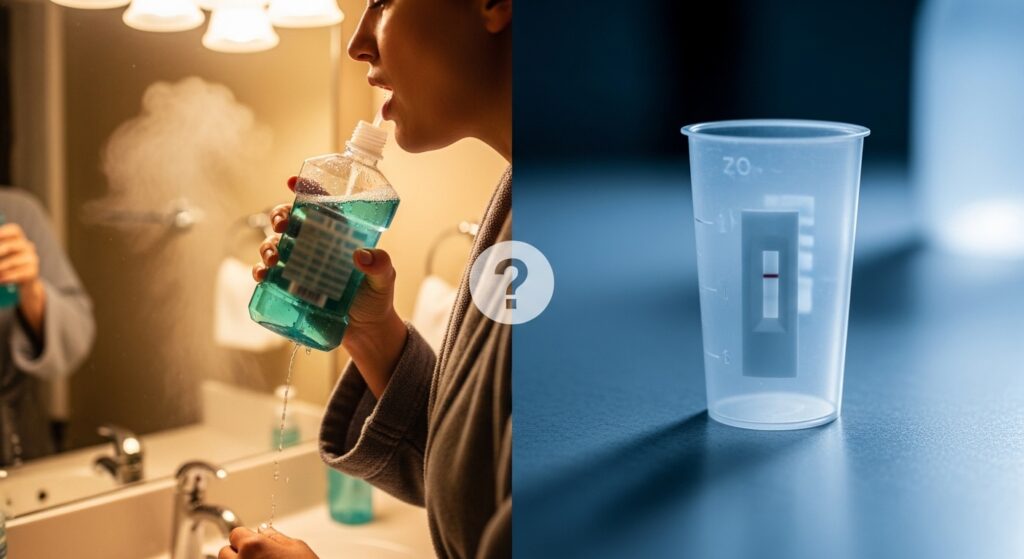
How Much EtG Does Mouthwash Produce in Urine? What Research Shows
This is the question that matters most for anyone asking: will mouthwash fail an EtG test?
The Costantino Study — Journal of Analytical Toxicology (2006)
The most cited investigation into incidental alcohol exposure urine test results was published by Costantino and colleagues in the Journal of Analytical Toxicology. Two controlled experiments examined the mouthwash ethyl glucuronide relationship directly.
Study One — Heavy single-session use: Nine volunteers gargled with an entire 4-oz bottle of 12% ethanol mouthwash over 15 minutes. Urine was collected for 24 hours afterward.
Results from 39 samples collected:
- 20 samples exceeded 50 ng/mL
- 12 samples exceeded 100 ng/mL
- 5 samples exceeded 200 ng/mL
- 3 samples exceeded 250 ng/mL
- 1 sample exceeded 300 ng/mL
All samples tested negative for ethanol itself — confirming the EtG originated entirely from mouthwash through oral mucosa ethanol absorption.
Study Two — Normal daily use over five days: Eleven participants gargled three times daily for five consecutive days. The highest EtG value recorded across all 55 first-morning urine samples was 120 ng/mL.
The 2010 PubMed Study — and Why It Doesn’t Actually Contradict This
A separate 2010 study examined mouthwash users who tested negative for EtG and EtS. This sounds contradictory — but it isn’t. That study used a lower-ethanol mouthwash with brief, standard gargling. The Costantino study used a full bottle of higher-concentration product over 15 minutes. This is a classic dose-response relationship: more ethanol, used more aggressively, produces more EtG. Minimal use of a weaker product may produce nothing detectable at all.
Both studies are accurate. Together, they confirm that how you use mouthwash matters as much as whether you use it.
EtG Positive 100 ng/mL from Mouthwash — The Cutoff Level That Determines Everything
This is the single most important variable in your situation, and the one most people never think to ask about. Understanding the EtG cutoff threshold separates people who pass from people who fail — even with identical EtG levels in their urine.
An EtG result is not positive or negative in absolute terms. It only becomes a positive when the concentration in your urine exceeds a predetermined threshold set by your specific testing program. The same EtG level of 150 ng/mL will pass one person and fail another depending entirely on which cutoff applies.
| Cutoff Level | Typical Use Case | Mouthwash Risk | Key Notes |
|---|---|---|---|
| 100 ng/mL | Strict zero-tolerance programs, some probation | HIGH | Normal daily mouthwash use can exceed this |
| 250 ng/mL | Some monitoring programs | MODERATE | Heavy, repeated high-alcohol product use is a risk |
| 500 ng/mL | Courts, DOT workplace testing, most labs | LOW | Research shows routine use tops out at ~120 ng/mL |
| 1,000 ng/mL | High-specificity screening | VERY LOW | Only catches substantive drinking |
Premier Biotech, a widely cited authority in forensic toxicology, refers to 500 ng/mL as the “Goldilocks” standard for court-mandated testing — sensitive enough to detect drinking within 48 hours, yet high enough that no documented case of incidental alcohol exposure urine test results from mouthwash, hand sanitizer, or food has ever produced a confirmed positive at this level.
The U.S. Department of Transportation mandates 500 ng/mL for federally regulated workplace testing. Most court systems in the US, UK, and Australia have adopted this same threshold. However, some strict probation programs and addiction treatment facilities operate at 100 ng/mL — and at that level, the mouthwash data is a genuine, documented concern. An EtG positive 100 ng/mL mouthwash explanation is scientifically valid and legally arguable.
Before your next test: ask explicitly what cutoff level your program applies. That single answer changes your entire risk profile.
Can Courts Distinguish a Mouthwash EtG False Positive from Actual Drinking?
Not perfectly — but forensic toxicologists have several tools that allow for reasoned interpretation when someone wants to contest an EtG positive from mouthwash.
EtG Level as an Interpretive Framework
| EtG Concentration | General Interpretation |
|---|---|
| Below 100 ng/mL | Incidental exposure likely; not typically considered consumption |
| 100–250 ng/mL | Ambiguous zone — incidental exposure or very light drinking |
| 250–500 ng/mL | Stronger evidence toward consumption; heavy product use still possible |
| Above 500 ng/mL | Strong indicator of actual alcohol ingestion |
| Above 1,000 ng/mL | Consistent with moderate to heavy drinking |
The EtG + EtS Dual Test: Most Reliable for Distinguishing Sources
When labs run EtG immunoassay vs LC/MS/MS confirmation alongside EtS (ethyl sulfate) testing simultaneously, accuracy improves considerably. EtS is a companion alcohol metabolite with slightly different pharmacokinetics. The combination produces a clearer picture:
- EtG positive, EtS negative at low levels: May support an incidental exposure argument and help contest a mouthwash EtG false positive
- Both EtG and EtS positive: Strongly consistent with actual ethanol consumption
- EtS positive alone: Can occur from non-beverage ethanol sources like nonalcoholic wine
The SAMHSA (Substance Abuse and Mental Health Services Administration) has issued formal advisories cautioning against using low EtG values alone as the sole basis for concluding that alcohol was consumed. This standard is now recognized in both U.S. and international clinical EtG testing incidental exposure policy guidance.
Creatinine and Dilution Checks
Labs also routinely assess creatinine levels to evaluate whether a specimen has been diluted. Abnormally low creatinine may indicate excessive water intake. A low EtG result paired with very low creatinine may trigger additional scrutiny — an important nuance in both routine monitoring and legal defense situations.
EtG Immunoassay vs LC/MS/MS Confirmation — What This Means for You
Most initial EtG screens use an immunoassay — a rapid, cost-effective method that detects EtG above a threshold but carries a higher rate of false positives. The EtG immunoassay vs LC/MS/MS confirmation distinction is critical in legal contexts.
LC/MS/MS (liquid chromatography–tandem mass spectrometry) is the gold-standard confirmatory method. It identifies and precisely quantifies EtG, with far greater specificity than immunoassay. Many forensic laboratories now require LC/MS/MS confirmation before a presumptive positive can be used in any legal or disciplinary proceeding.
If you receive a positive result and believe mouthwash caused a false positive alcohol test, request LC/MS/MS confirmation in writing before any formal action proceeds. This step has changed the outcome of numerous probation violation hearings. In many jurisdictions, the right to confirmatory testing is formally protected.
Alcohol Mouthwash Urine Test Probation: Which Products Are the Biggest Risk?
For anyone facing alcohol mouthwash urine test probation requirements, the practical answer is simple: switch products.
Highest Risk — Avoid These Before Any EtG Test
- Dr. Tichenor’s (~70% ethanol) — highest ethanol content of any widely sold mouthwash; avoid entirely during monitoring
- Listerine Original (~26.9%) — a Listerine EtG test positive is well-documented in clinical literature
- Listerine Cool Mint / Total Care (~21–22%) — similar risk profile to Original
- Scope Classic (~14–15%) — lower risk but relevant with heavy use
- Cepacol (~14%) — similar exposure profile to Scope
Best Mouthwash for Probation — Alcohol-Free Options That Are EtG Safe
If you’re asking “what is the best mouthwash for probation?” or “which is the alcohol-free mouthwash EtG safe option?”, these products are zero-risk:
- Biotène — enzyme-based, ideal for dry mouth and sensitive tissue
- ACT Restoring — sodium fluoride formula, cavity prevention focus
- CloSYS Original — chlorine dioxide base, very gentle on sensitive mouths
- TheraBreath Fresh Breath — oxygenated formula, widely available
- Tom’s of Maine Wicked Fresh — natural ingredient base, widely stocked
Look for “alcohol-free” or “ethanol-free” on the label. Check inactive ingredients for the absence of “ethyl alcohol” or “denatured alcohol.” These products are available at every major pharmacy chain across the US, UK, Australia, and Canada.
Non-Beverage Ethanol Sources EtG: Other Products That Can Affect Results
Mouthwash is the most frequently discussed non-beverage ethanol source EtG concern — but it is far from the only one.
| Product Category | Examples | Risk Level |
|---|---|---|
| Mouthwash | Listerine, Dr. Tichenor’s, Scope, Cepacol | Moderate–High (at 100 ng/mL cutoff) |
| Cough & cold medicine | NyQuil (~10% ethanol), Robitussin, Vicks | Moderate |
| Vanilla / almond extract | Pure vanilla extract (~35% ethanol) | High — documented to exceed 100 ng/mL |
| Hand sanitizer | Purell and most alcohol-based gels | Low–Moderate via skin/inhalation |
| Kombucha | Fermented tea (0.5–3% residual alcohol) | Moderate with large intake |
| Non-alcoholic wine / beer | Trace ethanol in many “0%” products | Low–Moderate |
| Breath sprays | Some formulations contain ethanol | Low–Moderate |
| Cosmetics / perfumes | Some carry ethyl alcohol in base | Very Low via skin contact |
Pure vanilla extract at approximately 35% ethanol deserves special attention. Even a standard baking quantity can push non-beverage ethanol sources EtG above 100 ng/mL. This has been documented in monitoring programs and most commonly affects people during the holiday baking season.
A Rare but Real Factor: Auto-Brewery Syndrome
A small number of individuals experience auto-brewery syndrome — a rare gastrointestinal condition in which yeast overgrowth ferments dietary carbohydrates into ethanol internally. The liver metabolizes this endogenous ethanol into EtG the same way it would process consumed alcohol, producing positive EtG results without any beverage intake.
This is uncommon but has appeared in documented court cases and published medical literature. For anyone who receives repeated, unexplained EtG positives despite strict abstinence and complete product avoidance, consulting a physician about gastrointestinal health is a reasonable next step.
Mouthwash Caused False Positive Alcohol Test — What to Do Right Now
If you believe mouthwash caused a false positive alcohol test, act immediately and systematically. The window to protect yourself is short.
- Document everything the same day. Write down every product you used in the 72 hours before the test — brand names, approximate amounts, times of use.
- Request the actual ng/mL value — not just “positive.” A result of 115 ng/mL is a fundamentally different situation than 650 ng/mL. You are entitled to this number.
- Confirm what cutoff level was applied. Ask your testing facility, probation officer, or program administrator directly. This determines whether your result even qualifies as a positive under standard court thresholds.
- Request LC/MS/MS confirmation in writing before any formal action is taken. If only an immunoassay was used, this step is critical — the EtG immunoassay vs LC/MS/MS confirmation distinction has legal significance.
- Request EtS to be tested simultaneously. An EtG positive paired with an EtS negative at low levels actively supports an incidental exposure argument when you contest EtG positive mouthwash claims.
- Consult a defense attorney experienced in forensic toxicology. EtG testing limitations are well-established in case law. Documented mouthwash exposure has been used successfully as a defense in probation violation hearings across multiple jurisdictions.
Global Context: How EtG Testing Incidental Exposure Policy Varies by Country
United States
The largest EtG testing market globally. SAMHSA guidelines shape clinical practice. The DOT mandates 500 ng/mL for federally regulated workplace tests. Court systems widely recognize 500 ng/mL as the standard for alcohol mouthwash urine test probation proceedings, though individual zero-tolerance programs often use 100 ng/mL.
United Kingdom
UK testing providers including AlphaBiolabs, Synectics Medical, and Cansford Laboratories typically promote combined testing approaches — blood alcohol markers alongside urine EtG — especially in child protection and family court proceedings. The multi-sample methodology reduces mouthwash EtG false positive risk. UK EtG testing incidental exposure policy guidance generally discourages relying on urine EtG alone.
Australia
EtG testing is used in driver’s license reinstatement programs, court-ordered monitoring, and workplace health schemes. Australian programs generally align with the 500 ng/mL standard for legal proceedings, though program-specific cutoffs vary.
Canada
Occupational health programs and addiction treatment compliance use EtG in Canada, with cutoff standards broadly mirroring US court-recommended levels. Individual policies vary by province and program type.
Pre-Test Safety Checklist — How to Prepare for an EtG Test If You Use Mouthwash
If you have a test scheduled, run through this list in the 48 hours beforehand:
- Switch to an alcohol-free mouthwash EtG safe option (Biotène, ACT, CloSYS, TheraBreath)
- Check all OTC medications for ethanol — replace NyQuil with alcohol-free cold formulas
- Avoid vanilla extract and almond extract in food preparation
- Skip kombucha and non-alcoholic beer or wine
- Stay adequately hydrated — normal urine concentration supports accurate results
- Disclose any unavoidable product use to the test collector at time of submission
- Confirm what cutoff level your program applies before the test date
- Keep product labels and receipts in case documentation becomes necessary
Frequently Asked Questions
Q: Can mouthwash cause a positive EtG result? Yes. Alcohol-containing mouthwash produces ethyl glucuronide (EtG) in urine through the same metabolic pathway as beverage alcohol. Whether it triggers a positive depends on the product’s ethanol concentration, how much you use, and your program’s cutoff threshold. At 500 ng/mL (the court standard), routine use is unlikely to cause a failure. At 100 ng/mL, it is a real risk.
Q: Does Listerine show up on an EtG test? It can. Listerine Original contains approximately 26.9% ethanol. A documented Listerine EtG test positive is clinically plausible, particularly at the 100 ng/mL cutoff level used by some probation programs. Under the standard 500 ng/mL court threshold, routine daily use is unlikely to cause a confirmed positive.
Q: What is the highest EtG level mouthwash can produce? Based on the Costantino et al. study published in the Journal of Analytical Toxicology, a single heavy-use session (full 4-oz bottle, 12% ethanol) produced a maximum EtG of approximately 300 ng/mL. Normal three-times-daily use over five days produced a maximum of 120 ng/mL. No documented incidental exposure from any product has confirmed a result above 500 ng/mL.
Q: Can I use Listerine while on probation? This depends on your program’s cutoff level. If your program uses 500 ng/mL, normal Listerine use is unlikely to cause a positive. If your program uses 100 ng/mL, the risk is real and you should switch to an alcohol-free alternative immediately. When in doubt, choosing the best mouthwash for probation — an alcohol-free product — eliminates the risk entirely.
Q: What does an EtG result of 120 ng/mL mean? A result of 120 ng/mL falls within the range produced by normal daily mouthwash use in peer-reviewed clinical research. At a 100 ng/mL cutoff, it registers as a positive. At 500 ng/mL, it does not. The meaning of this number is entirely determined by which cutoff your program applies.
Q: How do I contest an EtG positive from mouthwash? To contest EtG positive mouthwash results, document all product use from the 72 hours before the test, obtain the specific ng/mL value, request LC/MS/MS confirmation if only immunoassay was used, request EtS co-testing, and consult a defense attorney familiar with forensic toxicology. Courts in the US and UK have accepted mouthwash exposure as a valid defense when supported by documented evidence.
Q: Does NyQuil cause a positive EtG test? Yes, it can. NyQuil contains approximately 10% ethanol by volume. Taking multiple doses within 24–48 hours of a test can produce EtG above 100 ng/mL. Alcohol-free NyQuil formulas are available and should be the exclusive choice for anyone under EtG monitoring.
Q: What is the best alcohol-free mouthwash that is EtG safe? The top alcohol-free mouthwash EtG safe options are Biotène, ACT Restoring, CloSYS Original, TheraBreath, and Tom’s of Maine Wicked Fresh. All contain zero ethanol and cannot produce EtG in urine. They are available at major pharmacies in the US, UK, Australia, and Canada.
Q: What is LC/MS/MS and how do I request it as confirmation? LC/MS/MS (liquid chromatography–tandem mass spectrometry) is the gold-standard confirmatory method for EtG quantification. It is far more specific than an immunoassay screen. To request it, send a written request to your testing facility asking that any positive immunoassay result be confirmed by LC/MS/MS before any legal or formal action is taken. In many jurisdictions, this right is formally protected.
Q: Can vanilla extract cause a positive EtG test? Yes. Pure vanilla extract contains approximately 35% ethanol. Even standard baking quantities have produced EtG results above 100 ng/mL in monitoring programs. It is one of the most overlooked non-beverage ethanol sources EtG and should be avoided before any scheduled test.
Conclusion
Can mouthwash cause a positive EtG result? Yes — and the science has confirmed this since 2006. The key variable that determines whether it actually matters in your situation is the EtG cutoff threshold your testing program applies.
At the standard 500 ng/mL court threshold, no documented case of routine mouthwash use has produced a confirmed positive. At the stricter 100 ng/mL cutoff used by some probation and treatment programs, normal daily use of high-alcohol products like Listerine or Dr. Tichenor’s sits uncomfortably close to the line — and a mouthwash EtG false positive at this level is clinically real and legally defensible.
The safest action is clear: switch to an alcohol-free mouthwash EtG safe product before any monitoring period begins. Beyond that, know your cutoff level, audit your OTC medications for non-beverage ethanol sources EtG, disclose any product use to your collector, and understand that if mouthwash caused a false positive alcohol test, the tools to challenge it — LC/MS/MS confirmation, EtS co-testing, SAMHSA advisories, and published peer-reviewed research — are well-established and legally recognized across the US, UK, Australia, and Canada.
This article is for informational purposes only and does not constitute legal or medical advice. For questions about a specific test result or legal proceeding, consult a qualified attorney or licensed toxicologist.
References:
- Costantino A. et al. “The effect of the use of mouthwash on ethyl glucuronide concentrations in urine.” Journal of Analytical Toxicology, 2006; 30: 659–662.
- PubMed PMID 20223100: “Levels of ethyl glucuronide and ethyl sulfate in oral fluid, blood, and urine after use of mouthwash and ingestion of nonalcoholic wine.” 2010.
- Premier Biotech: “EtG Ethyl Glucuronide Testing” — 500 ng/mL court standard documentation.
- SAMHSA Substance Abuse Treatment Advisory, US DHHS, 2006.
- PMC3711108: “Clinical (Non-forensic) Application of Ethylglucuronide Measurement: Are We Ready?”
- Warde Medical Laboratory: “Ethyl Glucuronide: A Sensitive Marker for Alcohol Consumption.”
- MUSC College of Medicine, Clinical Neurobiology Laboratory: Urine EtG Testing guidance.