
Does Hand Sanitizer Affect an ETG Test?
Hand sanitizer can affect an ETG test under specific conditions. Ethanol-based sanitizers are absorbed through skin and inhaled as vapor in small amounts. At a 100 ng/mL cutoff, heavy or repeated use may produce detectable ETG levels. At the standard 500 ng/mL federal cutoff, normal use is unlikely to trigger a positive result.
That said, the full picture is more nuanced — and if you have a test coming up, the details matter.
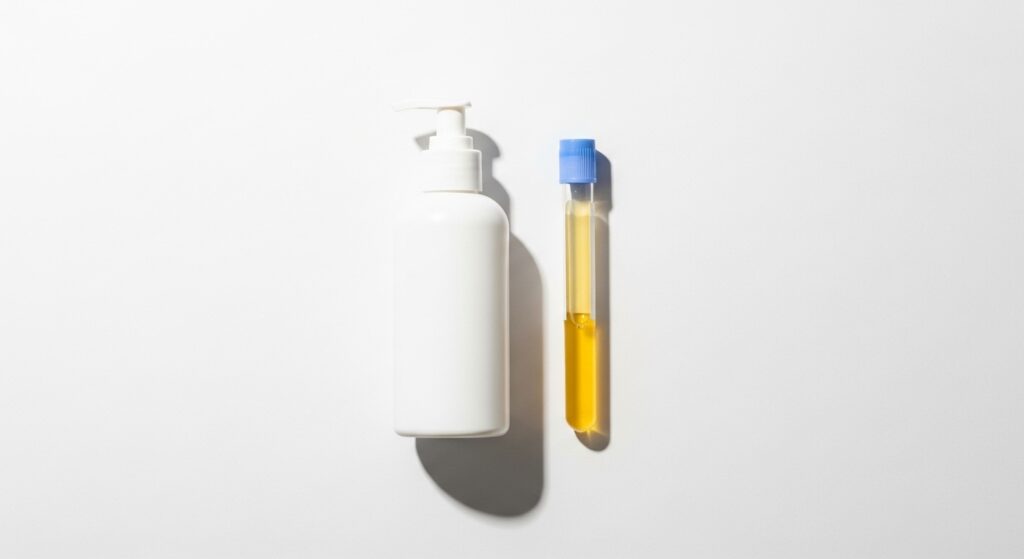
What Is an ETG Test and Why Is It So Sensitive?
An ETG test detects ethyl glucuronide, a direct metabolite your liver produces when it processes ethanol. Unlike a breathalyzer, which measures alcohol currently in your bloodstream, an ETG urine test looks for a byproduct that stays in your system long after the alcohol itself is gone — typically 24 to 80 hours after drinking, depending on how much was consumed.
ETG is used in probation monitoring, addiction treatment compliance programs, workplace alcohol testing in safety-sensitive industries, and family court proceedings. It’s chosen precisely because it’s highly sensitive. That sensitivity is also what makes it vulnerable to detecting alcohol from sources other than beverages.
Ethyl sulfate (EtS) is often tested alongside ETG. It’s another alcohol metabolite that is more resistant to bacterial degradation and fermentation artifacts, which makes the ETG/EtS combination useful when a result is disputed.
What’s Actually in Hand Sanitizer?
Most hand sanitizers sold in the US, EU, and Australia contain ethanol at concentrations between 60% and 85%. This is chemically identical to the alcohol in beer, wine, and spirits. Products like Purell — the most widely recognized brand — are ethanol-based.
Some sanitizers, particularly in certain Asian markets, use isopropanol (isopropyl alcohol) instead, typically at 70%. This is an important distinction: isopropanol is metabolized by your body into acetone, not ethanol. It does not produce ETG. If your sanitizer is purely isopropanol-based, it will not affect an ETG test at all.
The problem is that many people assume all sanitizers are the same. They’re not. Always check the active ingredient before assuming you’re in the clear.
| Sanitizer Type | Active Agent | Produces ETG? | Risk Level |
|---|---|---|---|
| Standard hand sanitizer | Ethanol 60–85% | Yes (in sufficient amounts) | Low to moderate |
| Isopropanol sanitizer | Isopropyl alcohol 70% | No | None |
| Alcohol-free sanitizer | Benzalkonium chloride | No | None |
| Hospital-grade ABHR | Ethanol or IPA | Depends on base | Varies |
How Does Hand Sanitizer Get Into Your System?
There are three routes, and most articles only discuss one of them.
Dermal absorption is the most commonly discussed pathway. Your skin is not a perfect barrier to ethanol — the outermost layer, the stratum corneum, allows small amounts to pass through. However, most of the ethanol in hand sanitizer evaporates within 15 to 30 seconds of application. Studies estimate that less than 1 to 3 percent of an applied dose is actually absorbed systemically during normal use. For a single pump of sanitizer, that’s a negligible amount.
Inhalation is the route almost no article mentions, yet it’s documented in the research. Ethanol evaporates rapidly from the skin surface, and the vapor is breathed in during and immediately after application. In an open, well-ventilated space, this is trivial. In a small room or car with repeated use throughout the day, the cumulative inhalation dose can become meaningful — particularly for healthcare workers following clinical hand hygiene protocols.
Incidental ingestion is the highest-risk route and the most clear-cut. If any sanitizer is accidentally swallowed — even a small amount — the absorbed ethanol dose is significant enough to produce measurable ETG. This is not just a concern for young children. It can happen through hand-to-mouth contact immediately after application before the product has evaporated.
The Cutoff Level Is Everything
This single variable determines whether hand sanitizer is a realistic concern for you — and most articles gloss over it.
| Cutoff Level | Used By | Risk from Sanitizer |
|---|---|---|
| 500 ng/mL | SAMHSA, DOT, US federal programs, UK courts, Canada | Very low — sanitizer use rarely approaches this |
| 100 ng/mL | State probation, private treatment centers, some Australian programs | Low to moderate — heavy occupational use may cross this |
| Below 100 ng/mL | Some specialized monitoring programs | Any incidental exposure can register |
The Substance Abuse and Mental Health Services Administration (SAMHSA) and the Department of Transportation (DOT) — which govern testing for truck drivers, pilots, railroad workers, and other federally regulated employees — use a 500 ng/mL cutoff. You can review SAMHSA’s official workplace drug testing guidelines to verify the current standards that apply to your program.
Many state-level courts, probation departments, and private addiction treatment programs use 100 ng/mL because it provides more sensitive sobriety monitoring. This is where the conversation changes. At 100 ng/mL, studies simulating healthcare worker conditions — with 20 to 30 sanitizer applications over an eight-hour shift — have produced median ETG values in the 40 to 90 ng/mL range, with some individuals exceeding 100 ng/mL.
If you don’t know which cutoff your program uses, find out before your test. It’s the most important piece of information you can have.
Who Is Actually at Risk?
For most people — someone who uses sanitizer a few times while running errands — the risk is minimal regardless of cutoff level. The concern is real but narrow.
Healthcare workers are the population most studied and most genuinely at risk. Nurses, surgeons, and clinical staff following alcohol-based hand rub (ABHR) protocols mandated by infection control guidelines may apply sanitizer 30 or more times during a single shift. If those workers are also subject to a 100 ng/mL monitoring program — which can happen in occupational health or court-mandated contexts — they are the group most likely to produce a borderline result from sanitizer alone.
People in treatment programs using 100 ng/mL cutoffs are the second-highest-risk group, particularly if they work in healthcare, cleaning, or food service environments where sanitizer use is frequent.
Federal employees and DOT-regulated workers at the 500 ng/mL threshold face essentially no realistic risk from normal sanitizer use.
What to Do Before Your ETG Test
This is the most practically useful section — and the one most competitors skip entirely.
- Find out your program’s cutoff level. Call the testing facility, your probation officer, or your treatment counselor. Ask directly whether the test uses a 100 ng/mL or 500 ng/mL threshold.
- Switch to soap and water for 24 to 48 hours before testing. This carries zero ETG risk and is equally or more effective for hand hygiene when done properly (20-second scrub technique).
- Switch to an alcohol-free sanitizer if soap isn’t available. Products using benzalkonium chloride as the active ingredient contain no ethanol or isopropanol. These are widely available at pharmacies globally. Read the label carefully — not all “gentle” or “moisturizing” sanitizers are alcohol-free.
- Eliminate other non-beverage alcohol sources. Alcohol-based mouthwash is a far higher ETG risk than hand sanitizer — switch to an alcohol-free formula for at least 48 hours before your test. Avoid fermented foods, vanilla extract in large quantities, and kombucha if you are on a strict monitoring program.
- If you work in healthcare, document your exposure. Keep a written log of the product name, approximate number of applications, date, and location. This is not paranoia — it’s the kind of contemporaneous evidence that carries significant weight if you need to explain a borderline result.
- Do not attempt to dilute your sample. Drinking excessive water before an ETG test does not reliably lower ETG below detection thresholds, and a creatinine concentration below 2 mg/dL will flag your sample as diluted — which in many programs is treated the same as a positive or refusal.
Best ETG Tools
Hand Sanitizer vs. Mouthwash: Which Is Worse for ETG?
This comparison comes up frequently, and the answer is clear: alcohol-based mouthwash poses a substantially higher ETG risk than hand sanitizer.
Mouthwash is applied directly to mucous membranes — the most permeable tissue in the body — and is often swallowed in small amounts. Studies have consistently shown that alcohol-based mouthwash can produce ETG readings of 100 to 300 ng/mL or higher, particularly with extended use or when used multiple times in a day.
Hand sanitizer, applied to intact skin and largely evaporated before absorption, produces far less systemic ethanol exposure by comparison. If you’re assessing which product to cut first before a test, mouthwash comes off the list before hand sanitizer does.
How to Challenge a Positive ETG Result
If you receive a positive ETG result and believe it reflects incidental exposure rather than drinking, the dispute process is specific and navigable.
Request confirmatory testing by LC-MS/MS. Initial ETG screens often use immunoassay methods (such as ELISA), which are sensitive but not definitive. Liquid chromatography–tandem mass spectrometry is the forensic gold standard and significantly more precise. Many programs require this confirmation before reporting a positive — but not all do. If yours doesn’t, request it explicitly.
Request EtS co-testing. Ethyl sulfate is less susceptible to false elevation from fermentation or environmental contamination. If your ETG is elevated but your EtS is low or absent, that pattern is inconsistent with beverage alcohol consumption and supports an incidental exposure explanation.
Involve a Medical Review Officer. An MRO is a licensed physician trained in occupational and forensic toxicology who reviews non-negative drug and alcohol test results. They have the authority to accept alternative medical explanations — including documented occupational exposure — and report a result as negative. If your program uses an MRO and you have a reasonable exposure explanation, requesting MRO review is your most direct path to a fair outcome.
Present your exposure documentation. Any contemporaneous records you kept — product names, frequency of use, work location — become evidence in this process. Paired with a toxicologist’s written opinion, documented occupational exposure has been accepted in court and program appeals.
What Alcohol-Free Hand Sanitizer Should You Use?
If you want to eliminate any ETG risk entirely, products containing benzalkonium chloride (BAC) as the active ingredient are your safest option. They contain no ethanol or isopropanol and are widely available in pharmacies across the US, UK, Canada, Australia, and Europe.
A few things to know:
- BAC-based sanitizers are somewhat less effective against certain viruses (particularly norovirus) compared to ethanol-based products
- They are more than adequate for routine bacterial protection
- Not all products marketed as “gentle” or “sensitive” are alcohol-free — always check the active ingredients panel, not just the front label
- In the US, FDA-regulated hand sanitizers must list their active ingredient clearly; products sold in less regulated markets may require closer label reading
Frequently Asked Questions
Does hand sanitizer show up on an ETG test? Hand sanitizer can produce low levels of ETG due to skin absorption and vapor inhalation of ethanol, but is unlikely to cause a positive at the standard 500 ng/mL cutoff. At a 100 ng/mL threshold, heavy occupational use — particularly in healthcare — can occasionally produce borderline readings.
How long does ETG from hand sanitizer stay in urine? ETG from incidental sanitizer exposure has a much shorter detection window than ETG from drinking. It would typically be undetectable within a few hours at relevant concentrations, compared to 24 to 80 hours after significant alcohol consumption.
Does isopropyl alcohol show up on an ETG test? No. Isopropanol is metabolized into acetone, not ethanol, and does not produce ETG. If your sanitizer uses only isopropyl alcohol as its active ingredient, it will not affect an ETG test result.
Can inhaling hand sanitizer fumes affect ETG levels? In ordinary ventilated environments, inhalation exposure is negligible. In enclosed spaces with very frequent use over a full workday, trace contributions are possible. It is a documented but minor exposure pathway under normal circumstances.
What is the difference between a 100 ng/mL and 500 ng/mL ETG cutoff? The 500 ng/mL cutoff is used by SAMHSA-governed federal programs and makes hand sanitizer a non-issue in practice. The 100 ng/mL cutoff is used by some state courts, treatment programs, and occupational programs — at this level, heavy sanitizer use by healthcare workers can occasionally produce detectable readings.
What is EtS testing and why does it matter? Ethyl sulfate is a second alcohol metabolite tested alongside ETG to improve accuracy. It is more resistant to fermentation and environmental interference. If your ETG is elevated but your EtS is not, that suggests an incidental or non-beverage source rather than actual drinking — which is critical information in a dispute.
Who is a Medical Review Officer and how can they help? A Medical Review Officer is a licensed physician with specialist training in drug and alcohol testing. They can review a positive result in context, consider alternative explanations including documented occupational exposure, and report the result as negative if the explanation is medically sound. Requesting MRO review is one of the most effective steps available to anyone challenging a borderline ETG positive.
Can I use alcohol wipes or hand wipes before an ETG test? Standard alcohol wipes contain ethanol or isopropanol. Ethanol wipes carry the same theoretical risk as hand sanitizer — low in practice but not zero at 100 ng/mL with heavy use. Switching to soap and water or BAC-based wipes before testing removes the question entirely.
Conclusion
Hand sanitizer is a real variable in ETG testing — but for most people, it is a manageable one. The risk scales with your cutoff level, your frequency of use, and your work environment.
At 500 ng/mL, the federal standard used by SAMHSA, DOT, and most internationally aligned programs, normal or even moderately heavy sanitizer use is not a credible concern. At 100 ng/mL, used by many treatment programs and state courts, healthcare workers and others with occupational exposure should take sensible precautions.
The most important steps are straightforward: know your program’s cutoff, switch to soap and water or an alcohol-free alternative in the 24 to 48 hours before testing, cut alcohol-based mouthwash well in advance, and if you work in a high-exposure environment, document it.
If you’ve already received a positive result you believe reflects incidental exposure, you have real options — confirmatory LC-MS/MS testing, EtS co-analysis, and MRO review are all legitimate paths to a fair outcome.
This article is for informational purposes only and does not constitute medical, legal, or toxicological advice. If you are enrolled in a formal monitoring program and have concerns about a test result, consult a qualified Medical Review Officer, toxicologist, or attorney.