
ETG Detection Window: Hours vs Days Explained for Urine, Blood, and Hair Tests
Understanding the ETG detection window is essential if you’re facing alcohol testing for work, legal requirements, medical monitoring, or personal accountability. Confusion often comes from conflicting claims about whether ETG lasts hours or days, and which test type matters most.
This guide breaks it down clearly—what ETG is, how it forms in the body, how long it remains detectable in urine, blood, and hair, and what factors influence results. It also covers real-world use cases, testing options, costs, accuracy limits, and common mistakes that lead to false positives.
What Is ETG and Why Is It Tested?
ETG, short for Ethyl Glucuronide, is a direct metabolite of ethanol (alcohol). When alcohol is consumed, the liver metabolizes ethanol primarily into acetaldehyde and acetate. A small fraction is processed through glucuronidation, forming ETG via the UGT1A1 enzyme.
Unlike ethanol itself—which clears from the body within hours—ETG remains detectable well after alcohol is gone from the bloodstream. That’s why ETG is widely used for alcohol monitoring, especially when abstinence must be verified.
ETG testing is commonly used by:
- Employers with safety-sensitive roles
- Courts, probation programs, and DUI monitoring
- Rehab centers and outpatient treatment programs
- Physicians monitoring liver health or sobriety
- Individuals tracking personal abstinence
For anyone looking to quickly estimate how long ETG may stay detectable after drinking, the ETG Calculator provides an easy-to-use tool to calculate detection windows based on sample type, alcohol amount, and timing.
ETG Detection Window: Hours vs Days (Quick Answer)
Short answer:
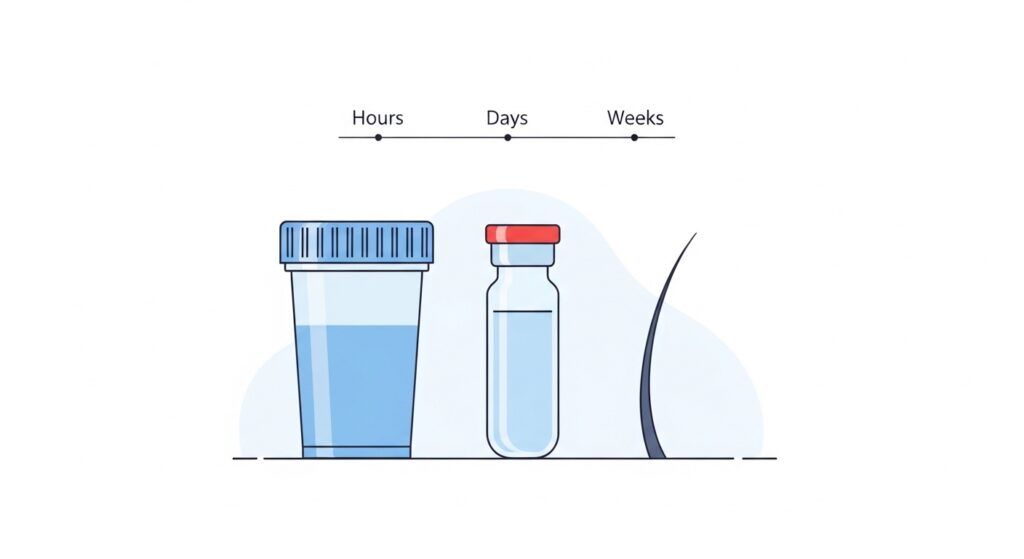
ETG can be detected in urine for 24–80 hours, blood for 12–36 hours, and hair for up to 90 days, depending on alcohol intake and test sensitivity.
The confusion around “hours vs days” exists because detection varies significantly by sample type, amount consumed, and individual metabolism.
Detection Windows by Test Type
Urine ETG Test (Most Common)
Urine testing is the standard method for ETG detection.
Typical detection range:
- Light drinking: 24–48 hours
- Moderate to heavy drinking: up to 72–80 hours
Urine ETG tests use cut-off thresholds, commonly 100 ng/mL, 300 ng/mL, or 500 ng/mL. Lower cut-offs detect smaller exposures but increase the risk of false positives from incidental alcohol exposure.
Best for:
- Workplace compliance
- Court or probation monitoring
- Rehab and outpatient programs
- Personal sobriety tracking
Limitations:
- Sensitive to dilution from excessive hydration
- Cannot pinpoint exact time or amount of alcohol consumed
Blood ETG Test (Less Common)
Blood ETG testing is rarely used outside clinical or research settings.
Typical detection range:
- Approximately 12–36 hours
Blood testing detects ETG for a shorter period than urine but offers higher precision for very recent alcohol use.
Best for:
- Clinical monitoring
- Situations requiring recent-use confirmation
Limitations:
- Invasive
- Short detection window
- Higher cost and limited availability
Hair ETG Test (Long-Term Pattern)
Hair testing detects ETG incorporated into hair shafts over time.
Typical detection range:
- Up to 90 days
Hair tests do not identify a single drinking episode. Instead, they reveal chronic or repeated alcohol use.
Best for:
- Long-term abstinence verification
- Family court or child custody cases
- Medical evaluations of chronic drinking
Limitations:
- Cannot confirm recent drinking
- More expensive
- Not suitable for short-term monitoring
Comparison Table: ETG Detection Windows
| Test Type | Detection Window | Primary Use | Key Limitation |
|---|---|---|---|
| Urine | 24–80 hours | Recent alcohol use | Dilution risk |
| Blood | 12–36 hours | Very recent use | Short window |
| Hair | Up to 90 days | Long-term patterns | No event timing |
What Affects How Long ETG Stays Detectable?
ETG detection is not the same for everyone. Several variables influence results.
Amount and Frequency of Alcohol Consumption
- One drink may produce detectable ETG for 24 hours
- Heavy or repeated drinking extends detection closer to 72–80 hours
Individual Metabolism
- Liver enzyme activity varies between individuals
- Liver disease can prolong ETG presence
Hydration Levels
- Overhydration may dilute urine samples
- Some labs flag diluted samples as invalid
Body Composition and Health
- Kidney function affects ETG excretion
- Certain medications may interfere indirectly
For readers who want a quick, personalized estimate of how long ETG might be detectable after drinking, try the ETG urine detection calculator at Alcohol Urine Test Calculator to factor in timing, alcohol amount, and test type.
How ETG Testing Works: Step-by-Step
Lab-Based ETG Testing
- Sample collection (urine, blood, or hair)
- Initial screening via immunoassay (IA)
- Confirmation using GC/MS or HPLC if positive
- Results reported with cut-off thresholds
Home ETG Test Kits
- Collect urine sample at home
- Apply sample to test strip or cassette
- Read result within minutes
- Confirm positives with a certified lab if required
Home kits are convenient but not accepted for legal or workplace decisions without lab confirmation.
Accuracy and Reliability of ETG Tests
Lab Testing Accuracy
- High sensitivity and specificity
- GC/MS confirmation minimizes false positives
- Accepted for legal and workplace compliance
Home Test Accuracy
- Useful for personal monitoring
- Higher risk of false positives or user error
- Not legally defensible
Common False Positives and Testing Risks
ETG tests are extremely sensitive. False positives can occur from non-beverage alcohol exposure, including:
- Alcohol-based hand sanitizer
- Mouthwash or breath sprays
- Certain medications or herbal products
- Cleaning products or cosmetics
Most labs recommend avoiding incidental exposure for 24 hours before testing whenever possible.
ETG vs EtS vs PEth: What’s the Difference?
ETG is often used alongside other biomarkers.
ETG (Ethyl Glucuronide)
- Detects recent alcohol use
- Sensitive but prone to incidental exposure
EtS (Ethyl Sulfate)
- Another ethanol metabolite
- More stable, less contamination risk
- Often used with ETG for confirmation
PEth (Phosphatidylethanol)
- Blood biomarker
- Detects chronic alcohol use over weeks
- Not affected by incidental exposure
Choosing the right marker depends on timeframe and purpose.
Legal, Workplace, and Medical Considerations
Workplace Testing
- Lab-confirmed urine ETG preferred
- Cut-off thresholds usually 500 ng/mL
- Policies vary by employer and country
Legal and Court-Ordered Testing
- GC/MS confirmation required
- Chain-of-custody procedures enforced
- Home tests not accepted
Medical and Rehab Monitoring
- Lower cut-offs often used
- Frequent testing schedules
- Combined ETG and EtS testing common
Global Testing Availability and Cost
ETG testing is widely available across the US, UK, Canada, Australia, and many EU countries.
Typical cost ranges:
- Urine ETG test: $50–$150
- Hair ETG test: $120–$260
- Blood ETG test: $80–$200
Costs vary by region, lab accreditation, and turnaround time.
Choosing the Right ETG Test: A Practical Framework
Ask yourself:
- How recent was alcohol consumption?
- Last 1–3 days → Urine
- Last 12–24 hours → Blood
- Long-term pattern → Hair
- Is this for legal or workplace use?
- Yes → Lab testing only
- No → Home testing may be sufficient
- Is accuracy or convenience more important?
- Accuracy → Lab GC/MS
- Convenience → Home kit
Key Mistakes to Avoid
- Overhydrating before testing
- Using home kits for legal decisions
- Assuming ETG proves intoxication level
- Ignoring incidental alcohol exposure
- Testing too early or too late
For medically reviewed information on how alcohol is processed and eliminated from the body, see the alcohol metabolism overview from Mayo Clinic
FAQs
How long does ETG stay detectable after one drink?
Typically 24–48 hours in urine, depending on metabolism and test sensitivity.
Can ETG detect drinking after two days?
Yes. Moderate to heavy drinking may be detected up to 72–80 hours.
Is ETG testing better than a breathalyzer?
ETG detects past use, while breathalyzers detect current intoxication only.
Can hand sanitizer really cause a positive ETG test?
Yes, frequent exposure may trigger low-level positives.
Are ETG hair tests accurate?
They are reliable for long-term patterns, not single drinking events.
Do all labs use the same cut-off levels?
No. Cut-offs vary depending on testing purpose and regulations.
Is ETG testing accepted worldwide?
Yes, but legal acceptance depends on local laws and lab certification.
Conclusion
The ETG detection window depends on what you’re testing, why you’re testing, and how the test is performed. Urine tests measure recent drinking over days, blood tests detect very recent use over hours, and hair tests reveal long-term patterns.
Understanding these differences helps you avoid false assumptions, choose the right test, and protect yourself from unnecessary consequences—whether for work, court, health, or personal accountability.