
How Long Does ETG Stay in Urine After 1, 2, or 3 Drinks?
Short answer: ETG (Ethyl Glucuronide) typically remains detectable in urine for 24–48 hours after 1–3 standard drinks, and sometimes up to 72 hours with sensitive lab testing. After heavy drinking, detection can extend to 80 hours or more.
However, the exact detection window depends on metabolism, liver function, hydration, and the cutoff level used by the testing program.
If you’re facing probation, workplace screening, DUI monitoring, or a court-ordered alcohol test, this guide breaks down exactly what you need to know.
What Is ETG?
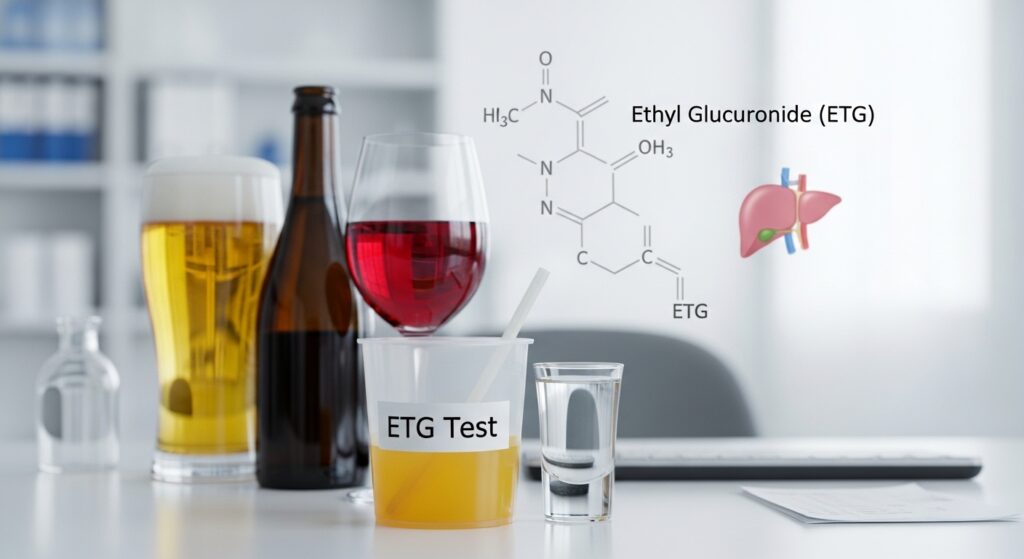
Ethyl Glucuronide (ETG) is a direct metabolite of ethanol (alcohol). When you drink beer, wine, or spirits:
- Ethanol enters your bloodstream.
- The liver processes it using enzymes like alcohol dehydrogenase (ADH).
- A small portion undergoes glucuronidation, forming ETG.
- ETG is excreted through urine.
Unlike blood alcohol concentration (BAC), which disappears within hours, ETG can remain detectable long after you feel sober.
ETG is commonly measured through urinalysis, often confirmed using advanced laboratory methods such as:
- LC-MS/MS (Liquid Chromatography–Tandem Mass Spectrometry)
- GC/MS (Gas Chromatography–Mass Spectrometry)
These are gold-standard toxicology techniques used in court-admissible testing.
ETG Detection Time After 1, 2, or 3 Drinks
Below is a practical breakdown based on light-to-moderate drinking.
After 1 Drink
- Typical detection window: 12–24 hours
- High-sensitivity tests (100 ng/mL cutoff): up to 36 hours
- Standard workplace cutoff (500 ng/mL): often clears within 24 hours
One standard drink equals:
- 12 oz beer (~5% alcohol)
- 5 oz wine (~12%)
- 1.5 oz spirits (~40%)
Even a single beer can produce measurable ETG.
After 2 Drinks
- Typical detection window: 24–36 hours
- Sensitive lab tests: up to 48 hours
- Higher cutoff tests: often under 36 hours
If you’re asking, “Will I pass an ETG test after 48 hours?” — in most light-drinking cases, risk decreases significantly by that point, but there is no absolute guarantee.
After 3 Drinks
- Typical detection window: 24–48 hours
- Sensitive tests (100 ng/mL): up to 72 hours
- Standard workplace screening (500 ng/mL): usually under 48 hours
Detection depends more on metabolism and cutoff level than simply drink count.
ETG Detection Time Chart
| Number of Drinks | Typical Window | 100 ng/mL Cutoff | 500 ng/mL Cutoff |
|---|---|---|---|
| 1 Drink | 12–24 hrs | Up to 36 hrs | <24 hrs |
| 2 Drinks | 24–36 hrs | Up to 48 hrs | 24–36 hrs |
| 3 Drinks | 24–48 hrs | Up to 72 hrs | 36–48 hrs |
| Heavy Drinking | 48–80+ hrs | 80+ hrs possible | 48–72 hrs |
Lower cutoff = longer detection window.
What Are ETG Cutoff Levels?
Cutoff levels determine when a result is considered positive.
Common Cutoffs
- 100 ng/mL – Very sensitive (often used in court monitoring)
- 250 ng/mL – Treatment programs
- 500 ng/mL – Workplace testing
- 1000 ng/mL – Less sensitive screening
Why Cutoffs Matter
A 100 ng/mL test may detect light drinking longer than a 500 ng/mL test. Courts and probation programs frequently use lower cutoffs for stricter monitoring.
Programs aligned with SAMHSA guidelines and DOT (Department of Transportation) compliance may apply specific thresholds depending on purpose.
What Affects How Long ETG Stays in Urine?
ETG detection time varies significantly.
1. Metabolism Rate
People metabolize alcohol differently. Genetics, enzyme levels, and liver efficiency play a role.
2. Liver Health
Conditions like fatty liver disease or hepatitis can slow elimination.
3. Hydration
Drinking water dilutes urine, but it does not eliminate ETG faster. Labs measure:
- Creatinine levels
- Specific gravity
- Color markers
Dilution can trigger retesting.
4. Body Composition
Body fat percentage and muscle mass influence alcohol distribution.
5. Drinking Speed
Rapid drinking increases peak ETG concentration.
6. Age and Sex
Women and older adults may metabolize alcohol differently due to body water composition and enzyme variation.
Will I Pass My ETG Test? A Practical Risk Framework
Use this structured guide:
Low Risk
- 1 drink
- 48+ hours elapsed
- 500 ng/mL cutoff
Moderate Risk
- 2–3 drinks
- 24–36 hours elapsed
- 100–250 ng/mL cutoff
Higher Risk
- 3+ drinks
- Less than 24 hours
- 100 ng/mL court-level testing
If your test is court-ordered, assume higher sensitivity unless confirmed otherwise.
How ETG Testing Works
Step 1: Urine Collection
- Supervised or unsupervised
- Temperature checked
- Chain-of-custody documentation for legal cases
Step 2: Initial Screening
- Immunoassay screening detects ETG presence
Step 3: Confirmation
- LC-MS/MS or GC/MS confirms levels with high precision
Confirmatory mass spectrometry reduces false positives and is court-admissible.
Lab Testing vs Home ETG Test Kits
Laboratory Testing
Used by:
- Probation programs
- DUI monitoring
- Physician Health Programs
- Substance abuse treatment programs
Pros:
- Highly accurate
- Legal admissibility
- Lower cutoffs available
Cons:
- Higher cost
- Requires clinic visit
Home ETG Test Kits
Available online and at pharmacies.
Pros:
- Privacy
- Immediate feedback
- Lower cost
Cons:
- Higher cutoff
- Not court-admissible
- Less precise than LC-MS/MS confirmation
ETG Testing Cost Worldwide
Average ranges:
- United States: $35–$150
- United Kingdom: £40–£120
- Canada/Australia: Similar adjusted ranges
Factors affecting price:
- Same-day testing
- Chain-of-custody documentation
- Confirmatory lab analysis
Major providers may include:
- Quest Diagnostics
- Labcorp
- Occupational health clinics
- Hospital laboratories
- Independent toxicology labs
Search terms like “ETG test near me” or “same day ETG testing” typically surface local providers.
ETG vs Other Alcohol Tests
ETG vs Breathalyzer
- Breathalyzer detects current intoxication (6–12 hours)
- ETG detects recent consumption (24–72+ hours)
ETG vs PEth Blood Test
- PEth (Phosphatidylethanol) detects drinking over 2–4 weeks
- Used for chronic alcohol monitoring
ETG vs Hair Alcohol Testing
- Hair ETG detects up to 90 days
- Used in long-term monitoring programs
Each test serves a different purpose in compliance monitoring.
Can You Reduce ETG Levels Faster?
There is no proven way to accelerate ETG elimination.
Common myths:
- Excessive water
- Detox drinks
- Heavy exercise
- Vitamin supplements
These methods do not remove ETG. Attempted tampering may result in:
- Specimen rejection
- Supervised retesting
- Legal consequences
Use Our Related Tools
- Advanced ETG Calculator – Offers enhanced calculation options for precise monitoring of ETG levels.
- Alcohol ETG Test Calculator – Designed specifically for alcohol metabolite detection in urine tests.
- ETG Detection Time Calculator – Determine how long ETG stays detectable after alcohol intake.
- ETG 100 ng/mL Calculator – Check your results against the standard 100 ng/mL threshold used in many alcohol tests.
Can Mouthwash Cause a Positive ETG?
Occasional incidental exposure (e.g., mouthwash) is unlikely to cause a confirmed positive at standard cutoffs. However, repeated heavy exposure to alcohol-containing products could elevate low-level readings.
In legal settings, confirmatory LC-MS/MS testing distinguishes incidental exposure from beverage alcohol consumption.
When Is ETG Testing Used?
ETG testing is common in:
- DUI probation programs (USA)
- Court-ordered alcohol monitoring (UK, Canada, Australia)
- Workplace drug testing
- Child custody cases
- Recovery and sober living programs
Courts prefer ETG because it extends the detection window beyond BAC testing.
When ETG Testing May Not Be Appropriate
ETG testing is not ideal for detecting:
- Long-term drinking patterns (PEth preferred)
- Immediate intoxication (breathalyzer preferred)
- Historical alcohol use beyond 3–4 days (hair testing preferred)
Choosing the right test depends on monitoring goals.
Frequently Asked Questions
1. Can 1 beer show up on an ETG test?
Yes. One standard beer can produce detectable ETG for up to 24 hours, sometimes longer with sensitive testing.
2. Is 72 hours enough to pass an ETG test?
For light drinking, 72 hours generally provides a wide safety margin, but individual variation exists.
3. Does water lower ETG levels?
Water may dilute urine, but it does not remove ETG faster. Labs check creatinine and specific gravity to detect dilution.
4. What is considered a high ETG level?
Levels above the program’s cutoff (often 100–500 ng/mL) are considered positive. Higher concentrations typically correlate with heavier or recent drinking.
5. What cutoff do courts use?
Many probation programs use 100 ng/mL or 250 ng/mL for stricter monitoring.
6. Can ETG detect binge drinking only?
No. ETG can detect light, moderate, and heavy drinking, depending on cutoff sensitivity.
7. How accurate is ETG urine testing?
When confirmed with LC-MS/MS or GC/MS, ETG testing is highly accurate and widely accepted in legal settings.
8. What happens if I fail an ETG test?
Consequences vary but may include probation violation, increased monitoring, treatment requirements, or employment action.
Conclusion
ETG typically remains detectable in urine for 24–48 hours after 1–3 drinks, and sometimes up to 72 hours with sensitive testing. Heavy drinking may extend detection beyond 80 hours.
Detection time depends on:
- Cutoff level (100 vs 500 ng/mL)
- Metabolism and liver health
- Hydration status
- Drinking pattern
If you are subject to probation, court monitoring, or workplace testing, understanding cutoff levels and timing is critical. When in doubt, assume a conservative detection window and consult your testing provider for specifics about their cutoff threshold and procedures.
Accurate information—not online myths—should guide your decisions.